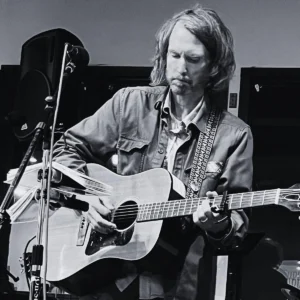
J Mascis Took Rick Rubin’s Advice Without Hiring Rick Rubin

Producers get paid large sums to tell bands to go back and listen to their first album. J Mascis worked out he could do it himself.
There Near arrives today, eleven tracks long, the sixth Dinosaur Jr album since the original line-up reformed and the first in a while to sound deliberately unpolished.
The Advice He Gave Himself
Mascis has been unusually clear about the mechanism. He acquired a 1970s Mesa Boogie MK1, the same model an engineer used when the band tracked their 1985 debut, and the tone followed.
“It has a real interesting sound I haven’t gotten for a while,” he said. Then the part that explains the whole record: “You always hear how Rick Rubin makes bands he’s producing sit down and listen to their first album and say let’s get back to that sound. So I just gave myself his advice.”
That is a genuinely funny thing to admit, and it is also a serious observation about what a producer of that kind actually supplies. The instruction is not technical. It is permission — an outside authority telling a band it is allowed to stop refining.
Bands rarely give themselves that permission, because every year of a career adds another reason to sound more capable than last time. Hiring someone to say the opposite is, in a sense, buying an argument you cannot win with yourself.
Mascis skipped the intermediary and bought an amplifier instead. It is cheaper, and on the evidence of the tone it works, which raises an awkward question about how much of the celebrated back-to-basics production job is really the equipment.
A Trio, a Year, and a Studio in Their Own Town
The making of the record matches its sound. It was created in short, intense bursts across the course of a year at Bisquiteen Studio in Amherst, and recorded almost entirely by the core three.
Murph is on drums, Lou Barlow on bass and vocals, Mascis on guitar and vocals, with piano and organ from a local musician, Ken Mauri. That is the whole cast.
Amherst is where the band formed in 1984, which makes the location less a choice than a return. A record about going back to a 1985 sound, cut in the town the band came from, is consistent to the point of being a little on the nose.
The working method matters as much as the room. Short bursts across a year is the opposite of a booked block, and it produces a different kind of record: nothing is attempted because the studio time is already paid for, and nothing gets over-refined because the session ends before boredom sets in.
It also fits three men who have known each other since the early eighties and do not need a warm-up week. A band that has played these songs’ ancestors for four decades can walk in, cut something, and leave.
The near-total absence of guests is the other tell. Their previous album, Sweep It Into Space, was co-produced by Kurt Vile and leaned poppier; this one has one outside musician on keys and no producer credited from beyond the circle.
Eleven Tracks and Where the Weight Sits
The record opens with “Several Got Away” and settles into a run of songs less interested in polish than in noise. Mascis’s guitar tone is described as more animalistic than usual, which for this band is a high bar.
“Everything At Once” is a clanging love song. “Take Me With You” carries two solos of the kind that provoke involuntary air guitar. Deeper cuts “Gone Off” and “Clam Along” do not reinvent the formula and are not trying to.
Eleven tracks is the length this band has always worked at, and the sequencing follows the pattern too — a loud opener, a mid-record showcase, and a couple of album tracks that exist to hold the shape rather than to be singles.
Our piece on where new rock is actually coming from covers the scenes a record like this now lands into, four decades after this band helped invent the template.
Barlow Takes Two, and Has a Target
Lou Barlow continues his long-standing arrangement of writing and singing a small number of the songs, and continues to make them count. He takes two of the record’s standouts, with “Blowin’ Up” ranked among his best.
Its subject is current: bored, doom-mongering keyboard warriors. That is a pointed thing for Barlow specifically to write about, given that his own most famous song outside this band was a very public airing of a grievance.
The history is worth restating, because it is why the current line-up is remarkable at all. Barlow was kicked out of Dinosaur Jr in 1989 after touring Bug, formed Sebadoh, and put “The Freed Pig” at the front of Sebadoh III in 1991 — a song documenting exactly how he felt about the way he had been treated.
A man who wrote the definitive song about being aggrieved in public is now, thirty-five years later, writing about people who are aggrieved in public for a living. Whether that is self-awareness or coincidence, it is a better lyric than the setup deserves.
The wider point is that Barlow’s two-songs-per-album allocation has become one of the band’s defining structures. It gives each record a second voice and a different writer’s instincts, and it is the clearest sign that the reunion is a functioning band rather than a Mascis solo project with familiar personnel.
The Reunion Is Now Four Times the Original
The arithmetic has quietly become absurd. The original line-up ran from 1984 to 1989, when Barlow was removed — five years. The reformation began in 2005 and has now produced six albums across twenty-one years.
The reunion has outlasted the original run several times over, without much fuss and without ever being treated as the main event. Most of the writing about this band still describes the eighties as the real period and everything since as an epilogue.
That framing is now indefensible on the numbers. Six albums is a career; three albums in five years by people who reportedly could not stand each other is a beginning.
The debut those six records keep circling was not, at the time, an event either. Dinosaur came out in 1985, recorded for around five hundred dollars at a home studio in the woods outside Northampton, and sold roughly 1,500 copies in its first year while the music press ignored it.
That is what makes the amplifier story more than gear talk. The sound Mascis went back for is not the sound of a triumph; it is the sound of three young men in a cheap room with nobody listening.
What Going Back Actually Means Here
Records made in pursuit of an earlier sound usually fail in one of two ways. Either the band cannot play badly enough to convince, or they can, and the result is a worse version of something that already exists.
The escape route is the one taken here: change the equipment and the working method rather than the writing. A different amplifier and a series of short sessions produce a rawer record without anyone having to pretend to be twenty-two.
It also means the songs are allowed to be what four decades of practice produce. A love song with a clanging guitar on it is not a 1985 song played through a 1985 amp; it is a 2026 song that happens to sound like it was recorded in a room.
Reviewers have landed on “solid” and “gnarly”, which is roughly the correct assessment of a band delivering exactly what it promised. Nobody comes to a Dinosaur Jr album for a surprise.
What they come for is the fuzz, the drawl, two Barlow songs and a solo that makes your hands move. Six albums into a second act longer than the first, that is still being supplied.
There Near is out now.
About The Author