Electronic

Marco Margna Spent Twenty Years on Other People's Records Before I Say No to You

Marco Margna Spent Twenty Years on Other People’s Records Before I Say No to You

The Estonian Producer Steps Out From Behind Other People's Records

Marco Margna released I Say No To You on 3 February 2026. It is a commercial vocal dance single, and it ships with a club mix attached. The audience is people who want their dance-pop sung rather than sampled. It comes from a producer who spent two decades making other people's records first.

https://open.spotify.com/track/2DOVeDtCxMjOEiwAZQ6Mhw

Marco Margna's music is in the playlist below, and this desk's coverage of him is collected on the Marco Margna profile. I Say No To You reached MusicDrops.News through PopHits.Co Music Charts, which verifies independent artists and places their releases across its network of music news desks. Put it on, then read on.


https://open.spotify.com/playlist/7LSn2pdm1phn9IASyfrO0M


Marco Margna Spent Twenty Years on Other People's Records Before I Say No to You

Twenty Years In The Studio Before Marco Margna Released His Own Single

Margna works out of Tallinn. The useful thing to know about him is that the studio came first.

By his own professional account he has spent twenty years arranging, mixing and mastering. He also writes advertising music and audio logos, and he has a longer-running interest in film. The last six of those years went into dance music, and into the sample and sound-bank material other producers buy.

That is an unusual order of operations. Most artists learn to record because they have songs. Margna had the craft first, and the catalogue followed. It shows in how he built I Say No To You, where nothing in the arrangement fights the vocal for room.

His catalogue up to this point was largely in Estonian. Kaotand pea, Tuhat aastat, On tõde vaid su enda sees, Me oleme noored, Nii kuum on öö and Deemon are all his. They are dance-pop records for a domestic audience rather than an export one. You're Always With Me was the first sign of the switch, and it came in two mixes, deep and afrohouse.

The One-Man Band That Feeds The Records

Alongside the releases there is a working performing life. Margna runs a one-man band across Estonia. He plays weddings, birthdays, company parties and private events, and he picks a repertoire that keeps a room dancing.

That is not a footnote to the recorded work. A performer watches which songs pull people onto a floor. He learns something a studio cannot teach, and you can hear it in what he chooses to keep short.

The background explains a second thing. A producer who spends six years supplying sound-bank material writes to someone else's brief, where the client owns the decisions. Releasing under his own name inverts that. The pop instincts on show here suggest he is comfortable with the swap.

What I Say No To You Does

The single is a refusal. The lyric addresses someone who has wasted the singer's time, and the chorus is the point where he stops absorbing it. Margna sings it plainly rather than belting it. That is the right call, because the line lands harder said than shouted.

It opens with bright synths and settles into a melody with a disco lean. Then it builds to the chorus over a four-to-the-floor arrangement. Good Music Radar reviewed the track in February 2026 and heard the same shape: a shimmering opening, a catchy disco-leaning melody, and a vocal that finally stands its ground. The review singled out the sound design. That is what you would expect from someone who mixes for a living.

The release runs to two tracks. The original is two minutes twenty-five, short by any standard and deliberately so. The club mix runs to three minutes ten. The extra time goes to the intro and outro a DJ actually needs.

From the Curator Team: "The two-version release is the tell. Cutting the single to two and a half minutes and then issuing a longer club edit solves two separate problems, one for a playlist and one for a floor. You only bother with that if you have stood behind a mixing desk at a real party and watched what happens when the intro is too short."

Who It Is For And Where Marco Margna Goes Next

The audience for this is specific. It is people who follow commercial vocal dance and electronic pop. They want a human voice at the centre of a dance record, and they are not after a twelve-minute progressive build. If your listening runs to vocal-led dance-pop with a clean top line, this sits inside your range.

The signal the release sends is the more interesting part. Moving from Estonian-language dance-pop to English widens the audience on purpose. Attaching a club mix says he wants DJs as well as playlists. The catalogue now splits across two languages, and the English side holds two entries. A third is the obvious next step.

I Say No To You is out now on Spotify.

Follow Marco Margna across platforms: Spotify artist page, SoundCloud, YouTube channel, Instagram, TikTok, and Facebook. He lists his live work on the official site.


Underworld Are Playing Festivals Across Three Continents

Underworld Are Playing Festivals Across Three Continents

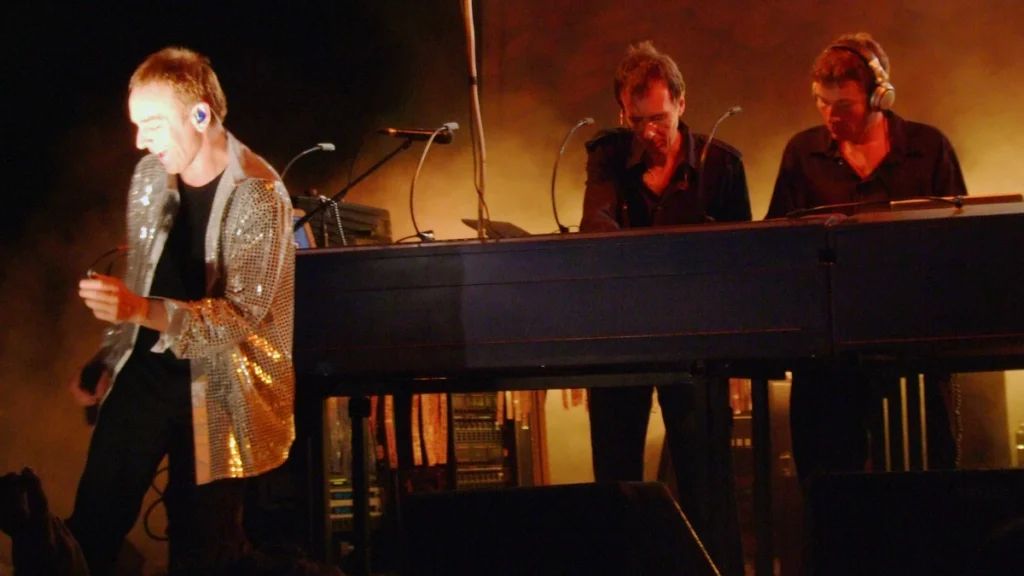
Underworld performing live in New York.

Underworld are working across three continents this year, from a field in Cheshire in late August to a festival in Mexico City in November.

The run continues the cycle behind Strawberry Hotel, and it is the kind of routing a band builds only when the live show is the point.

Cheshire, New York, Chicago, Pasadena, Mexico City

The dates are geographically scattered rather than routed as a conventional tour.

Creamfields in Cheshire on 27 and 28 August, the Knockdown Center in New York on 3 September, ARC Music Festival in Chicago three days later, the Rose Bowl in Pasadena on 7 November and Corona Capital in Mexico City on 21 November.

That is not a tour in the old sense of a bus moving between adjacent cities. It is a series of individually negotiated appearances spread across a year.

Electronic acts increasingly work this way, because a two-person setup can fly to a festival, play and leave without the freight and crew a band requires.

Festivals Rather Than a Headline Run

Almost all of these are festival slots rather than the band's own shows, which changes the economics substantially.

A festival pays a fee regardless of how many people attend, which removes the ticket-sales risk that a headline tour carries.

It also puts the act in front of audiences who came for something else, which is how a thirty-year-old catalogue keeps finding people who were not born when it was made.

The Knockdown Center Is the Outlier

One date is not a festival. The Knockdown Center in New York is a former glass factory converted into a venue, and it holds a fraction of the others.

Playing a warehouse-scale room between festival appearances is a deliberate contrast, and it produces a completely different show.

Electronic music at that scale works the way it was designed to: loud, in a dark room, with no seats and no sightlines to protect.

A Band Built on Live Performance

Underworld's reputation rests substantially on what happens on stage rather than on the records alone.

That is unusual in electronic music, where the studio is normally the primary site and the live show is a reproduction of it.

Their approach has been closer to a band's: tracks are rebuilt for performance, extended, restructured and driven by a vocalist working the room rather than a producer behind a laptop.

Two People and a Very Long Career

The core has been Karl Hyde and Rick Smith for decades, and the division of labour is unusually clear.

Smith builds the tracks; Hyde writes and delivers the words, which are closer to stream-of-consciousness poetry than to conventional lyrics.

That combination is why the live show works. A producer alone cannot hold a stadium field, and a vocalist alone has nothing to stand on.

The Trainspotting Problem

One track from the mid-nineties, attached to a film, remains their best-known recording by a very wide margin.

Songs of that magnitude are a permanent asset and a permanent constraint. The audience contains people who know one record and nothing else.

Bands handle it in one of two ways: refuse to play it, or play it well and let the rest of the set do the arguing. The second is more generous and considerably more difficult.

Strawberry Hotel as the Current Record

Strawberry Hotel is the album this touring cycle sits behind, and it arrived deep into a catalogue that already ran to a dozen records.

Albums that late in a career rarely change an artist's position, and they are not usually intended to.

What they do is give the live show new material and give promoters a reason to book, which is the actual function of a record for an act at this stage.

The Festival Economy for Legacy Electronic Acts

Festivals have become the primary employer for electronic acts with long catalogues, and the reason is programming rather than nostalgia.

A festival needs acts that can hold a large crowd at nine in the evening without the audience knowing the new material, and a thirty-year catalogue does that better than anything else available.

The trade is that the set becomes a greatest-hits proposition, which is a constraint on any act still making records.

Why the Routing Looks Random

Two dates in early September on opposite ends of the United States, then nothing until November, is not how a tour is normally built.

Festival calendars are fixed years ahead and do not coordinate with each other, so an act taking festival slots accepts whatever geography results.

For a two-person act the inefficiency is affordable. For a six-piece band with a production build it would be ruinous.

Creamfields and the British Dance Circuit

Creamfields is one of the largest dance festivals in Britain and occupies the August bank holiday weekend, which is the peak of the domestic calendar.

Britain's dance festival infrastructure is unusually developed, a direct inheritance of the rave era and the club culture that followed it.

An act of this vintage playing that event is being programmed as heritage and as a live draw simultaneously, which are not quite the same thing.

ARC and the American Rebuild

ARC Music Festival in Chicago is comparatively new and exists to reconnect American dance music with the city where house was invented.

American electronic festival culture spent a decade dominated by a very different commercial strain, and events like this represent a deliberate correction.

Booking a British act with a thirty-year history into that context is a statement about lineage rather than a booking of convenience.

The Rose Bowl and Scale

A November date at the Rose Bowl in Pasadena puts them in a stadium-adjacent setting, which is a different proposition again.

Electronic music in very large outdoor spaces has an acoustic problem: low frequencies disperse and the intimacy that makes a club work disappears entirely.

Acts that manage it do so by simplifying rather than expanding, which is the opposite of what the venue seems to invite.

Mexico City Closes the Year

Corona Capital in Mexico City is one of Latin America's largest festivals and has become a reliable stop for international acts.

The Mexican live market has grown substantially, and its audience is notably younger than the European one for the same acts.

Ending a scattered year there rather than at home is a reasonable indication of where the growth actually is.

Longevity in a Genre Without Much of It

Electronic music has produced very few acts with careers measured in decades, and the reasons are structural.

The technology changes every few years, the audience turns over faster than in rock, and most producers work alone without the band structure that sustains people through lean periods.

Acts that last tend to be the ones that built a live show rather than a studio practice, because a live show is a reason to keep going.

What Is Actually Being Tested

Two things. Whether a festival-led touring model keeps a catalogue alive or gradually reduces it to a fixed set of the same six tracks.

And whether new material can hold its place in a set alongside a song that has been famous for thirty years, which is the permanent problem of the long career.

Five appearances, three continents, two people, one field in Cheshire, and a catalogue old enough that most of the audience arrived after it was made.

FKA Twigs Won the Dance Album Grammy With Eusexua

FKA Twigs Won the Dance Album Grammy With Eusexua

FKA twigs performing live.

FKA Twigs won best dance and electronic album at the Grammys in February, beating a field that included two producers with substantially larger club followings.

The record takes its title from a word she invented for it, which is an unusual thing to build an album around.

An Invented Word as a Title

Naming an album after a coined term rather than an existing one is a specific decision with a specific cost.

A made-up word carries no associations, which means the record has to supply all of them. Nobody arrives knowing what it means.

The benefit is that the word belongs entirely to the album. There is no prior meaning to fight and no other artist can use it.

It also forces every piece of coverage to explain the title, which is a reliable way of making people repeat it.

A Dance Category She Had Not Competed In

Her previous records have generally been filed under alternative or art pop rather than dance, which makes this category placement a genuine shift.

Grammy categories are determined partly by the artist's submission and partly by a screening committee, so a change of category reflects a change in the work rather than a clerical decision.

Winning in a category she had not previously competed in is a stronger result than winning in a familiar one.

The Field She Beat

The category contained albums by Fred again, Rufus Du Sol and Skrillex, among others.

Those are producers whose primary context is the club and the festival main stage, with audiences built through dancefloors rather than through album cycles.

An art-pop artist taking a category from that field is a notable outcome, and it says something about how the voting body reads the word dance.

What the Category Actually Rewards

The dance and electronic album category has a long history of awarding records that are electronic in production but not primarily functional dance music.

That reflects the composition of the voting body, which is broad rather than specialist and tends to reward records that work as albums.

Club producers have periodically objected to this, and the objection is reasonable: a category named for dance music frequently goes to records nobody dances to.

Dancing as the Actual Subject

The record is unusual in the field because dancing is its subject rather than its function.

Most dance albums exist to be danced to and are not about dancing at all. A record that treats the club as a place with meaning is doing something different.

That is a natural position for an artist who trained as a dancer and whose live work has always been choreographed rather than merely staged.

A Dancer Before a Singer

She worked as a dancer before releasing music, appearing in other artists' videos, which is a background that shapes everything about the performances.

Artists who come from movement build shows around bodies in space rather than around a band on a stage.

It also affects the writing. Music made by someone thinking about how it will be moved to has different rhythmic priorities from music made for listening.

The British Art-Pop Lineage

She emerged from a British tradition that runs through electronic production, R&B phrasing and a visual practice treated as equal to the music.

That lineage has produced a run of artists whose records are consistently praised and rarely commercially enormous, which is a stable but narrow position.

A Grammy in a mainstream category is the kind of recognition that tradition does not usually receive.

Videos as Part of the Work

Her videos have consistently been treated as primary rather than promotional, with choreography, direction and design given the same weight as the songs.

That approach is expensive and increasingly rare, since most video budgets collapsed when the format stopped being a broadcast product.

What sustains it is that the videos do genuine work: they establish what the record is about in a way the audio alone does not.

The Eligibility Window

The award covered releases issued between 31 August 2024 and 30 August 2025, which is the standard twelve-month Grammy period.

Those dates matter more than they appear. A record released in September competes against a full year of subsequent releases, while one issued in August is judged almost immediately.

Artists and labels plan around the window deliberately, and release dates are frequently chosen with it in mind.

Winning Against Festival Producers

The two producers most associated with large-scale festival performance did not take the category, which is a recurring pattern.

Their records are built for a context that does not translate to album listening, and awards voters listen to albums.

That is not a criticism of either kind of work. It is a description of what the format rewards and what it cannot measure.

Club Music's Award Problem

Dance music has a structural difficulty with awards, because its primary unit is the track played in a room rather than the album played at home.

An award structure built around albums will systematically undervalue a form whose best work is often a twelve-inch single or a DJ set.

Attempts to fix this with recording categories help but do not solve it, since a single track still gets judged as a piece of recorded audio rather than as a functional tool.

Where the Album Sits in Her Catalogue

Her records have moved between registers across a decade: sparse experimental production, orchestral scale, and lighter mixtape-style work.

Moving into club-facing material is another step in that sequence rather than a departure from it.

Artists who change idiom regularly build a specific kind of audience, one attached to the person rather than to a sound, and that audience follows changes rather than resisting them.

What a Grammy Changes

For an artist at this level the practical effect is bookings and budget rather than sales.

A category win moves an artist up festival bills, unlocks larger production budgets and makes the next record easier to fund.

It also changes the framing permanently, since every subsequent piece of coverage will mention it.

Coining Words as a Practice

Inventing terminology for a body of work has a long history in art and a shorter one in pop.

It functions as a claim: this thing does not have a name because nothing quite like it existed before, which is a large statement to make and a difficult one to support.

The test is whether the word survives the album. Most do not, and the ones that do become genre names.

Why the Album Format Fails Dance Music

The mismatch between how dance music is made and how it is judged is worth setting out, because it explains most of the recurring arguments about this category.

A club track is a functional object. It is built to be mixed into another record, to hold a room for six minutes, and to work at volumes and frequencies that domestic listening cannot reproduce. Its structure — long intro, long outro, a breakdown positioned where a DJ needs one — exists to serve a person standing behind a mixer.

Played at home through small speakers, that same track sounds repetitive and oddly shaped, because every decision that made it useful has become a liability. Nothing about it is broken; it is simply being used for a purpose it was not designed for.

An awards process built on album listening therefore selects, almost automatically, for records that abandoned the functional requirements. That is not a conspiracy against club producers. It is what happens when you judge a tool by how it looks on a shelf.

What Choreography Does to a Record

Music written by someone who thinks in movement differs from music written by someone who thinks in arrangement, and the differences are specific enough to hear.

A choreographer is concerned with weight, transfer and recovery: where the body lands, how long it takes to get back up, and what the gap between those two things feels like. Those are rhythmic concerns before they are visual ones, and they translate directly into where the emphasis sits in a bar.

The practical result is music with unusual space in it. Passages that would be filled by a producer thinking about texture get left open, because the movement needs somewhere to happen.

It also produces records that reward being seen as well as heard, which is why performances by artists from that background so often feel like the completed version of the work rather than a promotional appearance for it.

What Is Actually Being Tested

Two things. Whether an artist can enter a genre category, win it, and be accepted by the audience that category belongs to.

And whether a record about dancing rather than for dancing counts as dance music, which is a definitional argument the award has now answered in one direction.

One invented word, four other nominees, a category she had never entered, and a dancer who made a record about the thing she did first.

Kaytranada Made the Polaris Long List a Decade After Winning

Kaytranada Made the Polaris Long List a Decade After Winning

Kaytranada holding the card announcing him as the 2016 Polaris Music Prize winner.

Kaytranada was longlisted for the 2026 Polaris Music Prize with his fourth studio album, released through RCA Records the previous August.

He won the same award outright in 2016, which makes the longlisting a return rather than an arrival.

What the Polaris Prize Measures

The Polaris is a Canadian award given to the best full-length album of the year judged on artistic merit alone, explicitly disregarding genre, sales and label affiliation.

That is an unusual set of criteria for a national music prize, most of which are structured around commercial categories.

The result is a shortlist that regularly contains records from throat singing, experimental electronic music, francophone pop and indie rock in the same year.

It also means the award functions as a genuine annual survey of Canadian music rather than as a popularity contest with a jury attached.

Forty Records, Then Ten

The process runs in two stages. A long list of forty albums is announced first, then narrowed to a shortlist of ten.

Making the forty is itself meaningful, because the field is every album released in Canada in the eligibility year across every genre.

The shortlist announced this year did not include him, which is the relevant outcome and not an unusual one for a previous winner.

Winning It in 2016

His 2016 win came for an album that was widely regarded as one of the defining electronic records of the decade in Canada.

Polaris wins tend to have a durable effect on an artist's standing, because the jury is composed of critics and the decision reads as a considered judgement rather than a market one.

Returning to the long list a decade later is a different kind of validation: not a breakthrough but evidence of continuity.

The Fourth Album

The record came out through RCA Records in August 2025, which places it inside the major-label system rather than the independent world where his early work circulated.

Producers who move from bandcamp-and-blog distribution to a major face a specific risk, since the sound that got them noticed frequently depends on operating without oversight.

Reaching a Polaris long list from that position suggests the transition has not flattened the work.

Montreal as a Base

He is based in Montreal, which has a distinct electronic scene shaped by a francophone cultural infrastructure and a set of grant and funding mechanisms that do not exist elsewhere in North America.

Quebec's music economy is genuinely different: publicly supported, linguistically protected and internally sustaining in a way the rest of the continent is not.

Artists working in English from that base occupy an unusual position, tied to a scene whose institutions are organised around a different language.

A Haitian-Canadian Producer

Born in Haiti and raised in Quebec, his rhythmic vocabulary draws on sources that most house and hip-hop production does not.

The characteristic feel of his tracks, a slightly loose and swung groove that never quite locks to the grid, is the most identifiable thing about the records.

That looseness is technically difficult. Programmed drums default to rigid timing, and producing swing that sounds human requires deliberate work against the software.

Producer Albums and the Guest Problem

Producer-led albums almost always carry a long guest list, because a producer needs voices and the format invites them.

The recurring failure is that the record becomes a compilation, with each track belonging to its featured artist rather than to the producer.

The successful version keeps the production forward enough that the album is recognisably one person's, which is the standard his catalogue has generally met.

Why House Music Suits This Format

His work sits in a house-derived idiom, which is a form built on repetition and groove rather than on song structure.

That gives a producer more room than a pop framework does, because a house track can develop across six minutes without needing a chorus.

It also means the vocals sit inside the arrangement rather than on top of it, which is what allows a guest-heavy record to still sound like the producer's.

The Massey Hall Ceremony

The winner is announced at a concert and ceremony at Massey Hall in Toronto on 22 September, with a prize of thirty thousand Canadian dollars.

Pairing the award with a performance is deliberate. Shortlisted artists play, which makes the evening a showcase rather than a presentation.

Massey Hall is also a specific choice: a nineteenth-century concert hall with a long history in Canadian music, recently restored.

What Thirty Thousand Dollars Does

The prize money is modest by international standards and significant in practice.

For an artist operating independently, thirty thousand dollars funds a recording, a video campaign or a touring shortfall, which is precisely the scale at which most Canadian albums operate.

The greater value is the attention. A Polaris shortlisting reliably produces a substantial and sustained increase in streaming and press coverage.

Previous Winners Rarely Repeat

The jury has historically favoured records that represent a moment rather than a career, which works against artists who have already won.

That is not a rule but a tendency, and it reflects a prize designed to identify significance rather than to reward consistency.

A previous winner reaching the long list and not the shortlist is therefore close to the expected outcome, whatever the record's quality.

Canadian Music's Structural Position

Canada has content quotas on radio, public funding for recording and touring, and a domestic industry that operates alongside rather than inside the American one.

Those structures produce a music economy where artists can build careers without international success, which is unusual in an English-speaking market next to the United States.

The Polaris sits inside that system as the critical counterweight to the commercial awards, and it is taken more seriously than most national prizes.

Ten Years Between Recognitions

A decade between a win and a long-listing is long enough for an entire generation of the jury to have turned over.

That matters, because it means the second recognition comes from different people applying the same criteria to a different record.

Consistency across a jury that has completely changed is a better signal than repeated recognition from the same one.

Why Swing Is Hard to Program

The looseness that defines this kind of production is a technical achievement rather than a stylistic preference, and it is worth explaining why.

Drum software places every hit on a grid subdivided into equal units, and anything recorded is snapped to the nearest one by default. The result is metronomically perfect and audibly dead, because no human drummer has ever played that way.

Swing settings exist to fix this, but they apply a uniform offset to every note, which produces a different kind of mechanical feel rather than removing it. Real groove comes from inconsistency: a snare fractionally late in one bar and on time in the next, a hi-hat that drifts and returns.

Producers who get this right generally do it by hand, moving individual hits off the grid by a few milliseconds each, or by playing parts live and refusing to quantise them. It is slow work that nobody notices when it succeeds and everybody feels when it fails.

What a Genre-Blind Prize Actually Rewards

Judging albums on artistic merit alone sounds straightforward and is close to impossible in practice, which is what makes the exercise interesting.

A jury comparing an experimental throat-singing record with a francophone pop album and a house producer's fourth LP has no shared criteria to apply. There is no metric under which those three things can be ranked, because they are not attempting the same task.

What juries fall back on is a rough test of ambition and execution: did this record set out to do something difficult, and did it succeed on its own terms. That favours albums with a clear conceptual identity over ones that are simply well made.

It also explains the tendency to reward moments over careers. A record that arrives as a statement reads as more ambitious than a fourth album doing what the first three did well, even when the fourth is the better record.

What Is Actually Being Tested

Two things. Whether a producer whose reputation was built on independent releases can keep the same sonic identity inside a major-label structure.

And whether a career built on groove rather than on songwriting holds critical attention across a decade, since the form is far more often praised than awarded.

Forty albums, then ten, a decade between recognitions, and a producer whose drums have never once sat exactly on the beat.

Arca singing into a microphone under blue stage light

Arca Made a Mixtape and Then Decided to Call It an Album

Arca spent nearly five years without a full-length record. When one finally arrived, it was a mixtape she had decided to relabel.

XXXXX came out on 31 July through XL Recordings, running forty-seven minutes and nine seconds across sixteen tracks in Spanish and English. She made it as a mixtape, then released it as an album without substantially reorganising the material.

The Designation Is the Only Thing That Changed

This is worth stating precisely because the temptation is to assume something was reworked. The running order was retained from the mixtape version, including several brief pieces sitting between the longer tracks, and the abrupt transitions that came with the original format survived intact.

Arca described the change in designation as a playful response to expectations surrounding her first full-length release in nearly five years — which is a fairly direct way of pointing out that the distinction was never in the music.

A mixtape and an album have been technically identical for two decades. Both are a set of tracks in an order, delivered digitally, and the labels now signal intent rather than format: a mixtape is understood as looser, less accountable, less of a statement, while an album invites the full weight of a review cycle.

Deciding to accept that weight for a record made under the other assumption is a real decision, and it makes the album's structural oddities into deliberate features rather than the leniencies of a lesser format.

Release material called three of the short tracks — "Cinch", "Enraptured" and "Throb" — "experimental diva FM" idents. An ident is radio furniture, the sound that separates one segment from the next, and describing them that way is an admission that the record is sequenced like a broadcast rather than composed as a suite. Our piece on why release metadata decides who hears you covers what a label like album or mixtape actually does downstream.

Five Albums in Eighteen Months, Then Nothing

The gap before this one has a specific cause. Arca released the five albums of her Kick series between June 2020 and December 2021, finishing the project by issuing its final four instalments on consecutive days.

That pace produced burnout. She has said she temporarily lost interest in making another album, and turned to painting instead.

Releasing four albums in four days is an extreme thing to do, and it is easy to read it as a stunt rather than as work. The five-year silence that followed suggests otherwise: it was not a marketing structure but an actual quantity of material, delivered at a rate that emptied her out.

Her reason for choosing painting is the most interesting detail in the whole story. She contrasted the endless revision possible in recorded music with painting, which required her to accept decisions that could not be undone.

That is the fundamental complaint about digital production stated plainly. A session file can be revisited indefinitely, so nothing is ever finished; a brushstroke is finished the moment it lands. An artist whose method is defined by extreme manipulation of sound went looking for a medium that would not let her manipulate anything.

An Exhibition Before the Album

The paintings became a series titled Angels, shown at the Institute of Contemporary Arts in London from 4 to 19 April 2026 — her first institutional presentation and the first London exhibition devoted to the series.

Arca has said the painting helped her resume making music, which suggests the detour was a route back rather than an exit. Whether the finality of the medium transferred into the record is a fair question to ask of an album that was released essentially as first drafted.

The rollout matched the tone. The album was announced on 20 July, eleven days ahead of release, with the artwork, tracklist and a livestream performance titled Diva.Experimental transmission, directed by Daniel Sannwald and broadcast from Barcelona.

Eleven days is a very short lead for a major release, and pairing it with a single broadcast event rather than a run of singles keeps the record as one object rather than a series of instalments — which is what the previous project had been.

It also removes the mechanism by which most albums are now introduced. A staged singles campaign lets listeners meet a record in pieces and decide in advance what it is; announcing everything at once and releasing it a week and a half later forces the first encounter to be with the whole thing.

For a record that keeps its interstitial pieces and its abrupt cuts, that is close to necessary. Extracted as singles, tracks built to be interrupted lose the thing that makes them work.

What the Music Is Doing

Early reviews described an experimental electronic record combining avant-garde production, deconstructed club, contemporary classical influences and pop structures, with recurring themes of transformation, futurism and transhumanism.

The arrangements move between sustained drones, walls of noise, metallic percussion, low-frequency pulses and more open passages built around fragments of her voice. Paul Attard, writing for Slant Magazine, connected the severity and unpredictability of the production to her earlier albums Xen and Mutant, but heard the same elements realised on a larger scale.

Ludovic Hunter-Tilney in the Financial Times described the textures on "Heart" as resembling blood circulating through a body, connecting them to the album's treatment of the body as something altered by technology.

Shaad D'Souza in The Guardian compared the production on "Everything" to Aphex Twin and identified a footwork influence in the quicker rhythm of "Fxck". That track repeats the phrase "kill the father", which Arca has explained as a rejection of internalised patriarchy and an attempt to make room for a maternal archetype and a different mythology.

"Raver" is the clearest illustration of the method. It rearranges the elements of mainstream dance music but replaces the conventional build and release with interruptions and bursts of noise — the shape of a club track with its central mechanism removed.

That is what deconstructed club means as a practice rather than a genre tag. The style takes the recognisable furniture of dance music — the kick, the riser, the drop — and withholds the payoff those elements exist to deliver, so the listener's expectation does the work the track refuses to do.

"Willow" sets the terms early, combining bells and computerised tones with disruptive percussion before handing over to the heavier low-frequency material of "Eidolon". A record that opens by establishing a texture and then immediately undermining it is telling you how to listen to the rest.

Two Languages and a Flamenco Title

The record moves between Spanish and English, and one track title makes the Venezuelan and Iberian threads explicit. "Taconeando" takes its name from the Spanish term for the heel-stamping used in flamenco and tango, tying the track's percussion to a specific physical movement.

That is a more grounded reference point than the album's futurist themes suggest, and it is characteristic. A record concerned with transhumanism naming a track after a dance step performed with the body's own weight is the sort of contradiction her work tends to hold rather than resolve.

The sequence works the same way. "No End" opens the album, followed by "Willow", "Eidolon", "Heart" and "Syncope"; "Cinch" separates "Raver" from "Fxck"; and near the close, "Enraptured" and "Throb" interrupt the run from "Grip" to "Everything".

Those interruptions are the mixtape showing through, and keeping them was the choice. An album is supposed to flow; this one was left with its seams visible, and then called an album anyway.

XXXXX is out now on XL Recordings.