Underworld Are Playing Festivals Across Three Continents
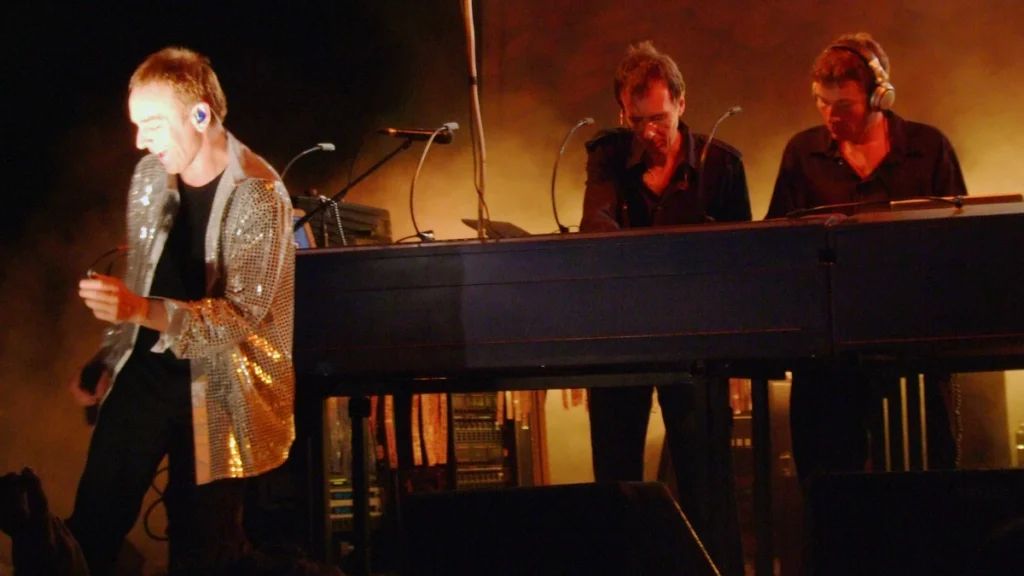
Underworld performing live in New York.
Underworld performing live in New York.
Underworld are working across three continents this year, from a field in Cheshire in late August to a festival in Mexico City in November.
The run continues the cycle behind Strawberry Hotel, and it is the kind of routing a band builds only when the live show is the point.
Cheshire, New York, Chicago, Pasadena, Mexico City
The dates are geographically scattered rather than routed as a conventional tour.
Creamfields in Cheshire on 27 and 28 August, the Knockdown Center in New York on 3 September, ARC Music Festival in Chicago three days later, the Rose Bowl in Pasadena on 7 November and Corona Capital in Mexico City on 21 November.
That is not a tour in the old sense of a bus moving between adjacent cities. It is a series of individually negotiated appearances spread across a year.
Electronic acts increasingly work this way, because a two-person setup can fly to a festival, play and leave without the freight and crew a band requires.
Festivals Rather Than a Headline Run
Almost all of these are festival slots rather than the band’s own shows, which changes the economics substantially.
A festival pays a fee regardless of how many people attend, which removes the ticket-sales risk that a headline tour carries.
It also puts the act in front of audiences who came for something else, which is how a thirty-year-old catalogue keeps finding people who were not born when it was made.
The Knockdown Center Is the Outlier
One date is not a festival. The Knockdown Center in New York is a former glass factory converted into a venue, and it holds a fraction of the others.
Playing a warehouse-scale room between festival appearances is a deliberate contrast, and it produces a completely different show.
Electronic music at that scale works the way it was designed to: loud, in a dark room, with no seats and no sightlines to protect.
A Band Built on Live Performance
Underworld’s reputation rests substantially on what happens on stage rather than on the records alone.
That is unusual in electronic music, where the studio is normally the primary site and the live show is a reproduction of it.
Their approach has been closer to a band’s: tracks are rebuilt for performance, extended, restructured and driven by a vocalist working the room rather than a producer behind a laptop.
Two People and a Very Long Career
The core has been Karl Hyde and Rick Smith for decades, and the division of labour is unusually clear.
Smith builds the tracks; Hyde writes and delivers the words, which are closer to stream-of-consciousness poetry than to conventional lyrics.
That combination is why the live show works. A producer alone cannot hold a stadium field, and a vocalist alone has nothing to stand on.
The Trainspotting Problem
One track from the mid-nineties, attached to a film, remains their best-known recording by a very wide margin.
Songs of that magnitude are a permanent asset and a permanent constraint. The audience contains people who know one record and nothing else.
Bands handle it in one of two ways: refuse to play it, or play it well and let the rest of the set do the arguing. The second is more generous and considerably more difficult.
Strawberry Hotel as the Current Record
Strawberry Hotel is the album this touring cycle sits behind, and it arrived deep into a catalogue that already ran to a dozen records.
Albums that late in a career rarely change an artist’s position, and they are not usually intended to.
What they do is give the live show new material and give promoters a reason to book, which is the actual function of a record for an act at this stage.
The Festival Economy for Legacy Electronic Acts
Festivals have become the primary employer for electronic acts with long catalogues, and the reason is programming rather than nostalgia.
A festival needs acts that can hold a large crowd at nine in the evening without the audience knowing the new material, and a thirty-year catalogue does that better than anything else available.
The trade is that the set becomes a greatest-hits proposition, which is a constraint on any act still making records.
Why the Routing Looks Random
Two dates in early September on opposite ends of the United States, then nothing until November, is not how a tour is normally built.
Festival calendars are fixed years ahead and do not coordinate with each other, so an act taking festival slots accepts whatever geography results.
For a two-person act the inefficiency is affordable. For a six-piece band with a production build it would be ruinous.
Creamfields and the British Dance Circuit
Creamfields is one of the largest dance festivals in Britain and occupies the August bank holiday weekend, which is the peak of the domestic calendar.
Britain’s dance festival infrastructure is unusually developed, a direct inheritance of the rave era and the club culture that followed it.
An act of this vintage playing that event is being programmed as heritage and as a live draw simultaneously, which are not quite the same thing.
ARC and the American Rebuild
ARC Music Festival in Chicago is comparatively new and exists to reconnect American dance music with the city where house was invented.
American electronic festival culture spent a decade dominated by a very different commercial strain, and events like this represent a deliberate correction.
Booking a British act with a thirty-year history into that context is a statement about lineage rather than a booking of convenience.
The Rose Bowl and Scale
A November date at the Rose Bowl in Pasadena puts them in a stadium-adjacent setting, which is a different proposition again.
Electronic music in very large outdoor spaces has an acoustic problem: low frequencies disperse and the intimacy that makes a club work disappears entirely.
Acts that manage it do so by simplifying rather than expanding, which is the opposite of what the venue seems to invite.
Mexico City Closes the Year
Corona Capital in Mexico City is one of Latin America’s largest festivals and has become a reliable stop for international acts.
The Mexican live market has grown substantially, and its audience is notably younger than the European one for the same acts.
Ending a scattered year there rather than at home is a reasonable indication of where the growth actually is.
Longevity in a Genre Without Much of It
Electronic music has produced very few acts with careers measured in decades, and the reasons are structural.
The technology changes every few years, the audience turns over faster than in rock, and most producers work alone without the band structure that sustains people through lean periods.
Acts that last tend to be the ones that built a live show rather than a studio practice, because a live show is a reason to keep going.
What Is Actually Being Tested
Two things. Whether a festival-led touring model keeps a catalogue alive or gradually reduces it to a fixed set of the same six tracks.
And whether new material can hold its place in a set alongside a song that has been famous for thirty years, which is the permanent problem of the long career.
Five appearances, three continents, two people, one field in Cheshire, and a catalogue old enough that most of the audience arrived after it was made.
About The Author