Max Richter Turned Sleep Into a Ninety-Minute Album
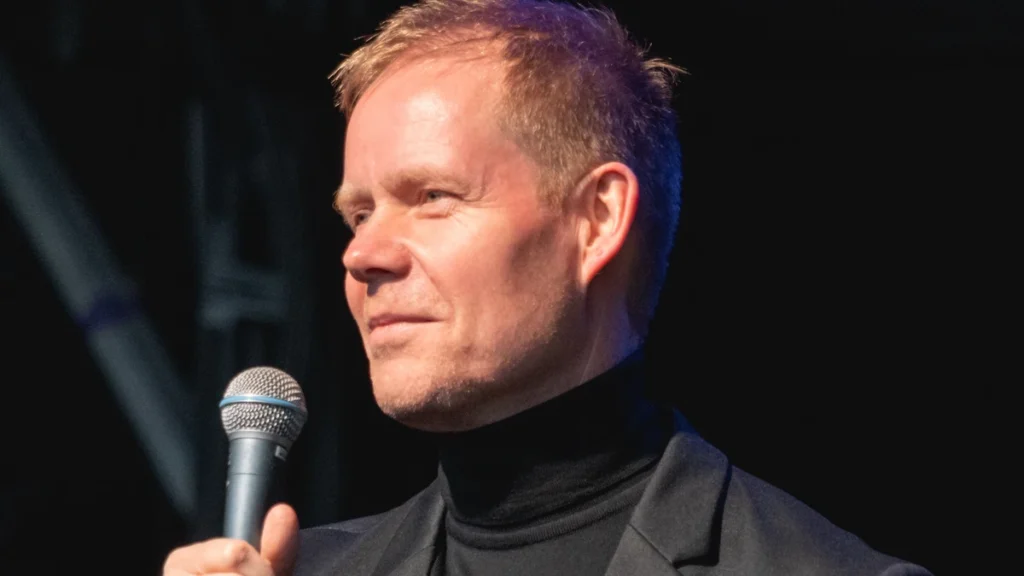
Max Richter speaking on stage in 2021.
Max Richter speaking on stage in 2021.
Max Richter released a ninety-minute work about the state between waking and sleeping, and spent this year touring two other programmes entirely.
It is a companion to the eight-hour piece he wrote a decade ago.
The Piece Before This One
A decade ago he wrote a work lasting eight hours, intended to be slept through rather than listened to.
The premiere performances were staged overnight with beds instead of seats, which turned a concert into something closer to a supervised night’s rest.
It was widely treated as a stunt at the time and has since become one of the most streamed contemporary classical works in existence, which is a reversal worth noting.
Very little about how it was received in the first year predicted where it ended up.
What the Hypnagogic State Is
The new record concerns the narrow window between being awake and being asleep, which has a name and a small research literature.
It is the period where thinking stops being sequential, where images arrive without being summoned, and where most people experience the falling sensation that jolts them back.
Writing music about it rather than for it is a different proposition from the earlier work, since the subject is a transition rather than a duration.
Ninety Minutes Instead of Eight Hours
The length is the clearest signal of intent. Eight hours is a night; ninety minutes is a concert.
The earlier piece was designed to be experienced unconsciously, which meant it could not have events in it. Anything memorable would have woken somebody up.
A ninety-minute work can have structure, incident and an ending, which returns it to something a listener is expected to follow.
Deutsche Grammophon and the Long Relationship
The album arrived through Deutsche Grammophon, a label whose catalogue is largely the standard classical repertoire.
Its willingness to release contemporary work of this kind is a relatively recent development, and a commercially motivated one, since the audience for the core repertoire is not growing.
What that produces is an odd shelf, where a new ninety-minute ambient work sits under the same imprint as a hundred years of orchestral recordings.
Two Programmes on the Road
The touring did not feature the new record at all. The programmes were his 2024 album and a work from twenty years earlier.
Pairing a recent album with a much older one is a standard concert construction, and it lets an audience hear how a composer’s language has changed without anybody having to explain it.
It also acknowledges that a substantial part of the audience came for the older piece, which is true and not worth pretending otherwise.
Seven Dates Across Europe
The European run went from Florence on 27 February to Ljubljana on 10 March, taking in Rome, Lucerne, Katowice, Vienna and Budapest.
Every one of those is a concert hall rather than a rock venue, and several are the principal classical rooms of their cities.
That routing places the work firmly inside the classical circuit rather than the crossover one, which is a positioning decision made venue by venue.
Vienna and Katowice in Particular
Two of those bookings carry more weight than the others.
The Vienna hall sits at the centre of the most conservative classical culture in Europe, where contemporary programming is contested in a way it is not elsewhere.
The Katowice hall is the opposite case: a modern building with an international reputation for acoustics, built for a Polish orchestra and used as an argument for public investment in music.
Twelve Days in North America
The American run opened on 12 June at Atlanta Symphony Hall and closed on 23 June at the Palace Theatre in Albany.
Twelve days is a short leg, and it is the shape a touring ensemble takes when the players have other commitments.
Finishing in Albany rather than New York is another instance of a pattern visible throughout this year’s fleet of tours: the last night is increasingly somewhere small.
A Film Score in November
He also scored a feature directed by Chloe Zhao, with the soundtrack released through Decca.
Film work has been a consistent part of the career rather than an occasional detour, and the two practices feed each other in a specific way.
Scoring teaches economy, because the music has to do one thing quickly and then stop, and composers who move between concert work and film tend to write shorter concert pieces as a result.
The Twenty-Year-Old Album
The older work on the touring programme dates from the early 2000s and remains the record most people know.
It arrived at a point when the category it now anchors did not really exist commercially, and it took years rather than months to find its audience.
Performing it two decades later, to rooms that sell out on its name, is a fairly complete answer to the question of whether it worked.
Why Long-Form Music Streams Well
The commercial success of extended ambient work is counterintuitive and has a straightforward explanation.
Streaming pays per play, and music used for sleeping, working or concentrating is played for hours at a time by listeners who never skip.
That makes long quiet pieces unusually well suited to the economics, which is why a form with no radio presence and no singles has become financially viable.
The Problem With Functional Music
There is a real criticism attached to that success, and it deserves stating.
Music optimised for use rather than attention risks becoming furniture, and the streaming platforms actively encourage this by organising it into playlists named after activities rather than composers.
The defence is that the intention matters: a piece written to be slept through is doing something deliberate, whereas a piece written to be ignored is doing nothing at all.
What Concert Halls Do for This Music
Quiet extended music makes demands a rock venue cannot meet, and the concert hall exists to meet exactly those demands.
The rooms are built so that a single sustained note carries to the back without amplification, and so that the silence between phrases is genuinely silent rather than filled with air handling and bar noise.
They also come with an audience that has agreed to sit still, which is a convention rather than a rule and is the single largest factor in whether this music works live.
Composers who move from clubs to halls almost always describe the same discovery: they can play far quieter than they thought, and the effect is larger rather than smaller.
Sequels to Conceptual Works
Returning to the territory of a famous piece a decade later is a risk with a well-documented failure mode.
The trap is repetition dressed as continuation, where the new work exists because the old one was popular and adds nothing to it.
The escape is to change the question. An eight-hour work asks what happens to music when nobody is listening; a ninety-minute one about the same subject asks what the edge of consciousness sounds like to someone awake.
Those are different pieces about a shared subject, which is the only version of a sequel worth making.
What Is Actually Being Tested
Two things. Whether a ninety-minute work about sleep can hold a listener who is expected to stay awake for it.
And whether touring two older programmes while the new record sits unplayed is confidence in the catalogue or avoidance of the new material.
Eight hours a decade ago, ninety minutes now, seven European halls, and a last night in Albany.
About The Author