Gorillaz Brought Six Late Collaborators Onto an Album About Death
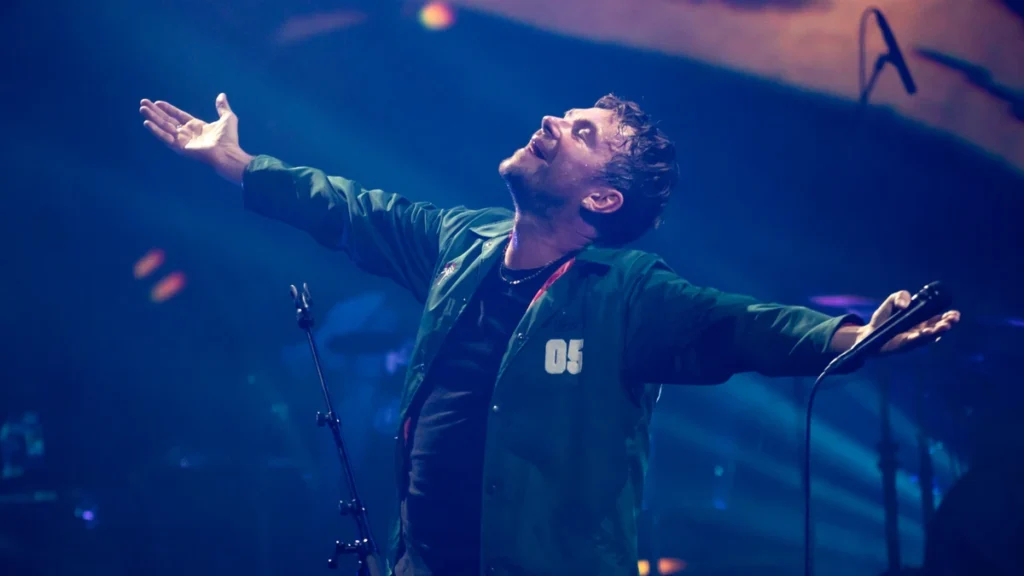
Six of the voices on the ninth Gorillaz album belong to people who are dead. That is not an accident of the archive; it is the record’s subject.
The Mountain — its title written in Devanagari as पर्वत — came out on 27 February through Kong, the band’s own label, distributed by the Sony subsidiary The Orchard. It runs sixty-six minutes and twenty-two seconds and is the first Gorillaz album released without Parlophone.
An Album Made After Two Deaths
The premise is not a conceit. Damon Albarn and Jamie Hewlett each lost a close family member before the band travelled to India to make the record, and both have described the result as a cohesive conceptual work about death and the afterlife, told through the band’s fictional characters.
The liner notes make the dedication explicit. It is inscribed to both men’s late fathers, to Hewlett’s late mother-in-law Amo, and to twelve past Gorillaz collaborators: Lou Reed, Ibrahim Ferrer, Dennis Hopper, Proof, Mark E. Smith, Tony Allen, Bobby Womack, David Jolicoeur, Ike Turner, Terry Hall, MF Doom and Craig Duffy.
That list is a quiet argument for how long the project has run. A band twenty-five years old has outlived a substantial share of the people who passed through it, and a record about death made by that band has an unusually deep bench of ghosts to draw on.
Six of them appear on the album itself. Dennis Hopper, Bobby Womack, David Jolicoeur of De La Soul, Tony Allen, Proof and Mark E. Smith all feature posthumously, which explains why the recording credits list sessions from 2001 to 2010 alongside 2024 and 2025.
Using Archival Vocals Is a Choice, Not a Trick
Posthumous appearances have become contentious, largely because the technology now exists to synthesise a voice that never said the words. That is not what is happening here.
These are recordings the collaborators actually made, in sessions they attended, across the band’s first three albums and the years around them. Using them on a record explicitly about the afterlife turns the archive into the argument rather than into a novelty.
It is also the only version of the idea that survives scrutiny. A song about the dead assembled from things the dead genuinely said has a claim to sincerity; the same song built from a model does not.
The living guest list is no less wide: Asha Bhosle, Asha Puthli, Anoushka Shankar, Black Thought, Idles, Johnny Marr, Sparks, Omar Souleyman, Trueno and Yasiin Bey. Two generations of Indian classical and playback singing sit alongside British guitar bands, American rap and Syrian dabke.
Recorded in Fourteen Places, Sung in Six Languages
The location list reads like an itinerary rather than a credit. Sessions took place at Studio 13 in London and Devon, Island City in Mumbai, 5020 and Criteria in Miami, and Sparks Studio in Los Angeles — and also in Jaipur, Rishikesh, New Delhi, Amritsar, Haridwar, at the Amber Fort in Rajasthan, on the ghats at Varanasi, in Ashgabat in Turkmenistan, in Damascus and in New York.
The performances are in English, Spanish, Arabic, Hindi, Yoruba and Russian, and the album draws heavily on Indian classical instrumentation alongside the band’s electronic and pop habits.
Recording at the ghats at Varanasi is the detail that ties the method to the theme. They are the cremation grounds on the Ganges where Hindu funeral rites are performed, and taking a record about death there is a decision about place rather than about sound.
The title came from the same trip. Albarn and Hewlett took it from their first visit to the Amber Fort in Jaipur, and from a mountain they had seen in western China while making the opera Monkey: Journey to the West.
Six languages on one record is a harder proposition than a long guest list suggests. A listener will understand at most two of them, so the majority of the vocal material has to work as sound and delivery rather than as text — which is closer to how instrumental music operates than to how pop usually does.
The production team was assembled to match. Albarn worked with Remi Kabaka Jr., James Ford, Samuel Egglenton and the Argentine producer Bizarrap, which is a set of hands spanning British indie production, Gorillaz’s own long-standing engine room, and Latin American electronic music.
They Played It Live Before Anyone Had Heard It
The reveal was unusual even by this band’s standards. On 3 September 2025 the album was performed in full as the final “mystery show” of four staged around Gorillaz’s twenty-fifth anniversary exhibition, House of Kong, in London.
The other three shows were complete performances of Gorillaz, Demon Days and Plastic Beach — the three albums the archival vocals largely come from. Playing the back catalogue and then the new record in sequence made the connection audible before it was explained.
Eight days later the band announced the album formally, with title, artwork, an original release date of 20 March 2026 and the lead single “The Happy Dictator”. Four more singles followed: “The Manifesto” in October, “The God of Lying” in November, “Damascus” in December and the double A-side “The Hardest Thing” / “Orange County” in January.
The date was then brought forward to 27 February, three weeks earlier than announced — the opposite of the usual direction of travel for a record of this scale.
Hewlett Wants You to Sit Through It
The band have been direct about how they expect the album to be used. Listeners are “supposed to listen to it from beginning to end”, Hewlett said, describing an attempt to “bring back that idea of taking time to invest in something, instead of this culture of scrolling”.
That is a large ask for sixty-six minutes, and it is the one part of the project the format works against. Our piece on what a new classical recording is competing with covers the same attention problem from the other end of the catalogue.
It is also consistent with everything else about the record. An album sequenced as a single argument about mortality, carrying voices from across twenty-five years, does not survive being sampled one track at a time.
The chart result suggests enough people accepted the terms. The Mountain entered the UK Albums Chart at number one — the band’s third UK chart-topper — and reached number seven on the Billboard 200, with what has been described as widespread critical acclaim for its thematic ambition and stylistic cohesion.
Leaving Parlophone Was the Practical Decision
Underneath the concept sits a structural change. This is the first Gorillaz album not released through Parlophone, arriving instead on Kong with distribution handled by The Orchard.
A distribution deal is not a record deal. The label keeps a percentage and moves the product; the creative and financial control stays with the artist, along with the risk.
For a sixty-six-minute conceptual album about grief, recorded in fourteen locations across six countries with an eleven-strong living guest list and archival vocals to clear, that control is not an ideological point. It is what makes the record possible.
A deluxe edition and a Special Edition followed, which is the other half of owning your own release — the ability to keep issuing versions on your own schedule rather than a label’s.
The timing of the move is worth noting. Bands usually leave a major label after a commercial decline, when the deal has stopped being worth its terms to either side. Gorillaz left before making the record that went to number one, which reverses the usual causality.
Albarn had signalled the ambition well in advance. Ahead of the band’s Coachella headline slot in 2023 he said the next album would take the pair somewhere they had never been, and later called it a “paradigm shift”. Work began after he finished his adaptation of the second part of The Magic Flute, at which point he and Hewlett went to India.
The Mountain is out now on Kong.
About The Author