Panda Bear Built an Album From Harp Loops and a Mariachi Band
The instrument list on the new Panda Bear and Sonic Boom record reads like a list of things that do not belong together: harp, steel drum, pedal steel, and a mariachi band from Mexico City.
A ? of WHEN arrived on 10 July through Domino, ten tracks long, the follow-up to the duo’s 2022 album Reset.
Four Instruments That Should Not Cohere
The press material describes a record “built on loops of harp and sequences of steel drum, webs of pedal steel, and even bits of a mariachi band from Mexico City”.
Each of those carries a very strong association. Harp signals the classical concert platform or something deliberately ethereal. Steel drum means the Caribbean, and in most pop contexts means it lazily. Pedal steel means country. A mariachi band means Mexico so unambiguously that using it at all risks sounding like a postcard.
Putting all four on one record is either a mess or a method. The clue that it is the second is the word “loops”: these are not guest performances dropped into arrangements but sources being cut into repeating figures, which strips an instrument of its context and leaves only its texture.
That is the technique the duo already used on Reset, which was built on samples of early rock and roll records looped into something that no longer sounded like its source. Applying it to a harp and a mariachi horn section is the same idea aimed at less obvious material.
Real Players, Not Just Samples
The collaborators confirm it is not purely a sample exercise. Noah Lennox and Pete Kember are joined by the harpist Mary Lattimore, the British multi-instrumentalist Daniel O’Sullivan — known for work with Sunn O))) and Ulver — and the steel guitarist Zena Kay.
Lattimore is a significant name in her own right, an experimental harpist whose solo records use effects and looping rather than classical technique. Hiring her is a signal that the harp on this album is meant to sound like her harp rather than like an orchestral one.
O’Sullivan comes from an even further-out tradition — drone metal and Norwegian experimental music — and his presence suggests the record’s textures go somewhere darker than the instrument list implies.
That combination of played and looped material is harder to assemble than either alone. A sampled loop is fixed; a live player can be asked to change, and reconciling the two means deciding, repeatedly, which one the track is actually built on.
There is a clearance dimension too. Building an album from samples of existing recordings, as Reset did, means negotiating with rights holders before anything can be released; commissioning musicians to play the material you want to loop removes that constraint entirely.
Recording a mariachi band in Mexico City rather than sampling one from a record is the clearest instance of that. It costs more and takes longer, and it means the parts can be written rather than found.
An Album About Being Tired of the Internet
The subject matter is the deliberate counterweight. Against what the announcement called the more playful sonic output, the pair address “online exhaustion and pervasive depression” alongside “political chicanery and ecological sustainability”.
Online exhaustion is a difficult thing to write about without sounding either preachy or dated. It is also, at this point, close to a universal condition, which makes it more like weather than like a topic.
The musical approach may be the point. A record made from looped fragments of unrelated sources is structurally a description of scrolling — disconnected material arriving in sequence, each piece stripped of the context that would explain it.
Whether that reading is intended or imposed, the pairing works: bright, warm, faintly absurd instrumentation carrying lyrics about depletion is a more honest picture of the experience than a bleak arrangement would be. Our piece on what pre-saves and pre-adds actually do covers the machinery on the other side of that fatigue.
Six Weeks From Announcement to Release
The rollout was brief. The album was announced on 27 May with the title track, and released on 10 July — a six-week window, short for a record with this much going on inside it.
Leading with the title track rather than the most immediate song is consistent with the rest. It presents the album as an object with a name and a shape, not as a container for a single.
The title itself resists being typed correctly, which is either a joke about search or an accident. A ? of WHEN contains a punctuation mark and a capitalised word, and it is the kind of title that survives on being recognised rather than looked up.
Domino has released both this and Reset, which gives the collaboration a stable home. A duo project between two established artists frequently ends up on whichever label one of them happens to be signed to; a second album on the same imprint suggests it is treated as a band rather than as a side venture.
Ten tracks is the other decision worth noting. It is short enough to be heard in one pass and long enough to establish a method, which for a record built on unfamiliar combinations is close to the minimum viable length — a listener needs to hear the approach more than once before it stops sounding accidental.
What Each of Them Brings
The partnership is unusual in that both halves have long histories. Lennox has released six solo albums as Panda Bear since 1999, including Person Pitch, Tomboy and Panda Bear Meets the Grim Reaper, the latter two reaching the Billboard 200.
He is also a co-founding member of Animal Collective, who spent most of 2025 marking the twentieth anniversary of Feels — which places this record immediately after a year of looking backwards.
His work outside both projects covers a wide spread: Daft Punk’s “Doin’ It Right”, Dean Blunt’s “9”, and Braxe + Falcon’s “Step by Step”. That is a musician who has spent twenty-five years being useful to people making very different records.
Kember’s contribution is harder to summarise briefly and easier to hear. His production work has long been defined by treating repetition and drone as the structure rather than the background, which is precisely what a record built on loops of harp requires.
Two albums in, the collaboration has stopped being an experiment. What A ? of WHEN adds is the demonstration that the method works on material with no obvious relationship to each other.
The pairing also solves a problem each of them has separately. A solo Panda Bear record carries the whole weight of a distinctive voice with nothing to push against; a Kember production without a strong singer can drift into pure texture. Together the parts constrain each other.
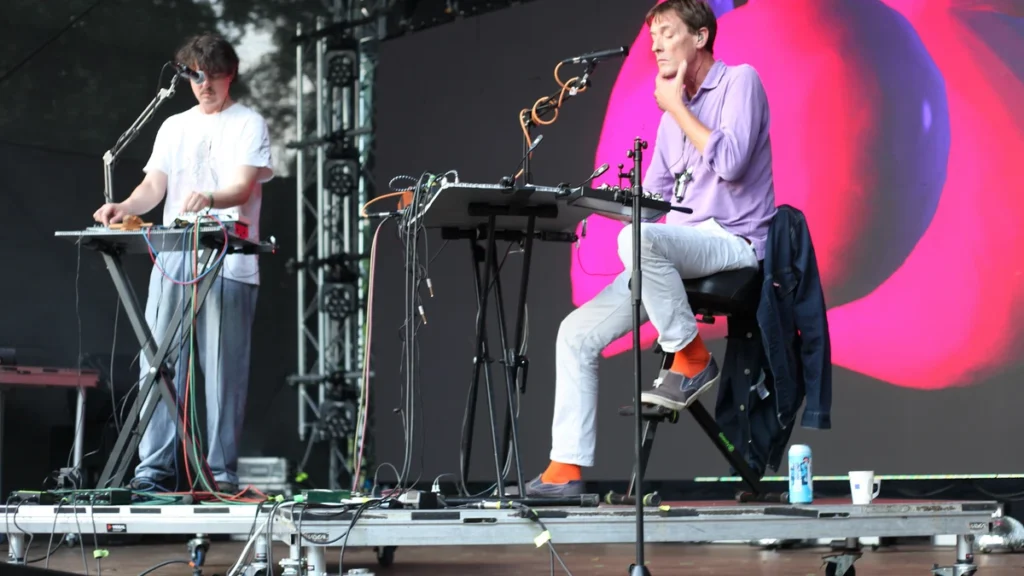
The touring picture supports that reading. The two have been playing festival stages together through 2026, performing as a duo behind keyboards rather than assembling a band — a live format that matches how the records are built.
What the album does not do is resolve into a single sound. Ten tracks assembled from four unrelated instrumental traditions will never be tidy, and the evidence of Reset is that tidiness was never the objective.
A ? of WHEN is out now on Domino.
About The Author