Pop

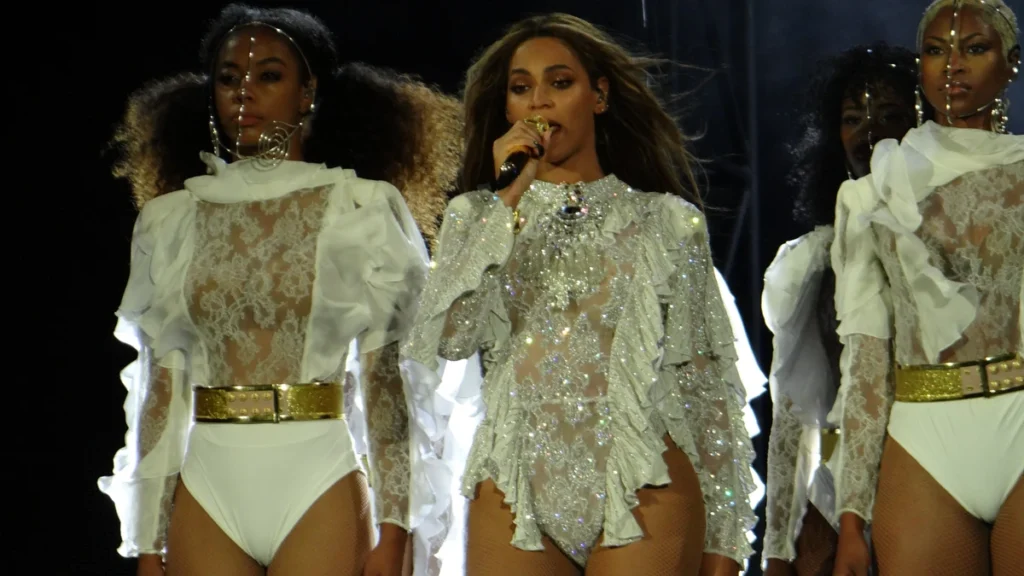
Beyonce singing into a microphone on stage flanked by dancers

B’Day Returns With Thirty-One Tracks and a Selena Duet

Beyonce performing live

B'Day is out again, twenty years on, and this time it runs to thirty-one tracks. The expanded edition arrived alongside the album's twentieth anniversary and Beyonce's birthday on 4 September, and it is a genuine expansion rather than a remaster with two bonus cuts attached.

The headline addition is a duet that could not have been made at the time. Irreemplazable (Como La Flor) folds Beyonce's Spanish-language version of Irreplaceable together with Selena Quintanilla's Como La Flor, released with permission from Selena's estate. Beyonce had previously cited Selena as an influence on the Spanish-language material from this era, which is what makes the pairing read as a closing loop rather than a novelty.

What Is New on the Record

Three tracks are previously unreleased. Alongside the Selena duet there is Cuerpo (Tumbao), a rework of Get Me Bodied featuring Maluma and built on a sample of Celia Cruz's La Negra Tiene Tumbao, and Can I Watch You, produced by Beyonce with Pharrell.

The vault material fills out the rest. Three B-sides return in Lost Yo Mind, Creole and Back Up, and My First Time appears from the sessions for 2003's Dangerously in Love, which puts a track older than B'Day itself on a B'Day reissue. Morning Dew (Donk), released in July, is also included, with the JAY-Z remix that followed in August.

Production credits on the new material are specific. Cuerpo (Tumbao) is produced by Beyonce, Edgar Barrera and CASTA, with co-production from Ali "Ali Ali" Alvarez. Can I Watch You is a Beyonce and Pharrell production. Consequence listed the full contents when the edition landed.

The Physical Editions

The packaging is where the twentieth-anniversary framing shows. The deluxe physical set is four LPs on 180-gram blue vinyl with a 60-page booklet and two art prints, sitting above standard two-LP and CD editions.

A 60-page booklet is a substantial object for a reissue, and it signals the intended buyer: someone who owned the record in 2006 and wants the artefact, rather than someone discovering it on a playlist. The four-LP length is a straightforward consequence of the track count, since thirty-one songs will not fit on two discs at listenable cutting levels.

That split between a 31-track digital edition and a collector's vinyl set is now the standard shape of a major anniversary release. The digital version does the streaming work and the physical version does the revenue.

Maluma Found Out in Public

The Maluma feature is the first collaboration between the two artists, and his reaction arrived on Instagram Story in Spanish rather than through a label statement. "I can't believe it. I never imagined I'd be saying this," he said, before adding "Colombia en la casa, carajo" and calling the track, in his own words, an enormous flex.

That is a more useful data point than it looks. Consequence reported the reaction, and the unguarded delivery suggests the feature was kept tightly under wraps until release, which is consistent with how this campaign has been run generally.

Musically, the track does something more interesting than a guest verse. Get Me Bodied was already a percussion-led record, and pushing it through La Negra Tiene Tumbao moves it into a different rhythmic tradition rather than layering one on top. A bilingual version of a twenty-year-old album track is a reinterpretation, not a remix.

What Beyonce Says She Was Doing in 2006

The press release accompanying the reissue carries a statement from Beyonce about what she was aiming at first time round, and it is more specific than most artist reflections on their own back catalogue. "Hip-hop was taking over at the time, but I was fighting to preserve the bridges, melodies, and harmonies that have always been at the heart of R & B," she said. "The goal was to blend those two worlds through the art of sampling. I loved the minimalism of a beautiful vocal arrangement over a simple drum loop or a classic guitar like 'Irreplaceable'…but only if that 808 was banging underneath."

That is a useful description of the record's actual construction, and it explains why the anniversary edition leans so heavily on sampling rather than on remixes. Cuerpo (Tumbao) applies the stated method to a new set of source material two decades later, which makes it continuous with the album rather than bolted onto it.

At the time of release, ABC News reported, she had said she wanted the album to be big, hard, up-tempo and energised, which is the shortest accurate description of B'Day anyone has managed. The reissue includes remastered versions of the original tracks alongside the Spanish-language recordings, and features from the era include Alejandro Fernandez, Voltio and Pharrell.

Why This Album Gets the Treatment

B'Day arrived on 4 September 2006 and won Best Contemporary R&B Album at the 2007 Grammys. It has always occupied an unusual position in the catalogue: made quickly, dense with percussion, and more aggressive than the album before it, which is why its reputation has risen steadily rather than peaking on release.

An anniversary edition works best when the vault has something in it, and this one clearly did. Three unreleased tracks plus four archival cuts is a real haul from a period two decades old, and it suggests the sessions produced considerably more than the original running order used.

The Spanish-language thread is the part that has aged most interestingly. Irreemplazable was a serious commercial move at the time rather than a token gesture, and building the anniversary around a Selena pairing and a Colombian feature makes explicit what the original edition only implied.

The Permissions Behind the Two Big Tracks

The two most striking additions both required somebody outside the project to say yes, which is the part of a vault release that never appears in the tracklist. Neither could have been assembled by opening a hard drive.

Irreemplazable (Como La Flor) needed Selena Quintanilla's estate to grant permission for a posthumous pairing. An estate controls not only the recording and the composition but the reputational question of who the artist is heard beside, and that second consideration is why so many proposed posthumous duets never happen. Approving one means accepting an interpretation of the artist's legacy that the artist cannot revise.

Cuerpo (Tumbao) required a different clearance. Building it on Celia Cruz's La Negra Tiene Tumbao means licensing both the master and the underlying composition, and doing so for a track that is itself a rework of an existing Beyonce recording. That is a stack of rights three deep on a single song, before Maluma's new verses are added on top.

The production credits show the same layering. Beyonce, Edgar Barrera and CASTA are credited as producers on Cuerpo (Tumbao), with Ali Alvarez co-producing, which is a four-name credit block on a reinterpretation of a song that already had its own producers in 2006. Anniversary editions are usually described as archival exercises, and the archival parts here genuinely are: the three B-sides and the Dangerously in Love outtake needed nothing but a decision to release them. The two headline tracks are new commissions wearing an archival label, and they are the reason this edition is worth more than a remaster.

What Reissues Are Competing With Now

A thirty-one-track edition is not a small ask of a listener's attention, and it lands in a market where catalogue is competing directly with new releases for the same streaming minutes. The physical side of the same release is doing well, which MusicDrops.News noted when Kylie Minogue took a Christmas reissue to number one.

The mechanics reward it. A deluxe edition re-enters the album into the release cycle with new metadata, which puts it back in front of algorithmic surfaces that would otherwise treat it as a twenty-year-old record. Three previously unreleased tracks give editorial playlists something legitimately new to add.

The risk is dilution: a listener arriving at B'Day for the first time now meets a thirty-one-track object rather than the tight thirteen-song record that built its reputation. Most streaming services keep the original edition available separately, which is the sensible answer, but the deluxe is what the algorithm will surface.

What to Play First

Start with Irreemplazable (Como La Flor), because it is the track that could only exist now and required a decision by another artist's estate to be possible at all. Then Cuerpo (Tumbao) for the rhythmic rework, which is the most substantial reimagining of an existing song here rather than an addition beside it.

Can I Watch You is the one for people who track producers, since a Beyonce and Pharrell co-production held back for two decades is an unusual thing to release without ceremony. The three B-sides are for completists, and My First Time is a curiosity from a different album's sessions.

After that, the original thirteen tracks are still there and still work in sequence. Twenty years is long enough for a record to stop being a recent album and start being a reference point, and B'Day crossed that line some time ago.
Rosalia Recorded Lux With the London Symphony Orchestra

Rosalia Recorded Lux With the London Symphony Orchestra

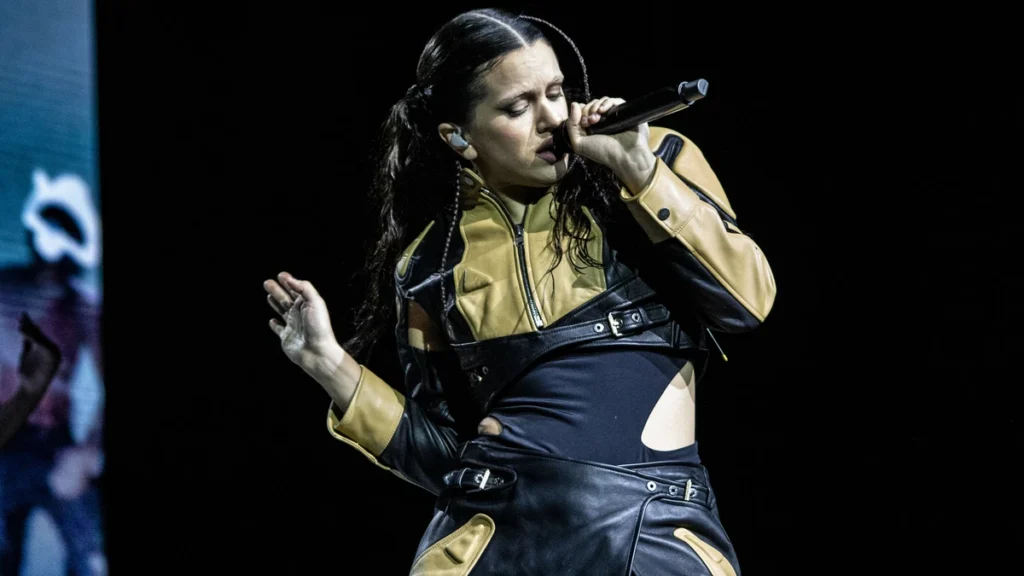
Rosalia performing in Chile.

Rosalia recorded her fourth studio album with the London Symphony Orchestra, conducted by Daniel Bjarnason, and released it through Columbia Records in November 2025.

It produced the biggest streaming debut ever recorded for a female Spanish-language artist and the strongest commercial opening of her career.

A Full Symphony Orchestra

Using the London Symphony Orchestra on a pop record is a substantial and expensive decision, and it is not the same as adding strings.

A full orchestra requires the music to be scored, which means every part written out for players who read rather than improvise, and a conductor to hold it together.

That changes the composition process fundamentally. Songs have to exist as notation before they exist as recordings, which is the opposite of how pop is normally built.

It also means the arrangements are fixed. An orchestral session is booked by the hour and the parts cannot be reworked in the room the way a small band's can.

Who Bjarnason Is

Daniel Bjarnason is an Icelandic composer and conductor who works across contemporary classical music and film scoring.

Hiring a working composer rather than a session conductor is a meaningful distinction. A composer conducting somebody else's material brings a structural ear to it rather than simply executing the score.

His involvement also places the record in a specific contemporary-classical lineage rather than in the older tradition of pop-with-strings.

The Biggest Spanish-Language Debut

The streaming record is the headline figure and it is worth reading carefully.

Spanish is the second most spoken native language in the world, and the Latin American streaming market is enormous, so a Spanish-language record has a very large potential base.

What has historically limited Spanish-language artists is not audience size but industry infrastructure and playlist gatekeeping, both of which have shifted substantially in the last decade.

Forty-Two Arena Shows

The tour runs forty-two arena dates across seventeen countries, opening in Lyon in March and closing in San Juan in September.

That is a full year of touring at arena scale, which is a level very few Spanish-language artists have reached outside the Latin American market.

Seventeen countries is also unusually broad. Most arena tours concentrate on a handful of high-density markets rather than spreading across a continent.

Lyon to San Juan

The routing begins in France and ends in Puerto Rico, which describes the two poles of her audience.

European dates account for the artistic and critical reputation, while the Caribbean and Latin American dates account for the linguistic and commercial base.

Closing in San Juan rather than Madrid or Barcelona is the more interesting choice, and it places the endpoint in the Caribbean rather than in Spain.

Touring an Orchestral Record

The practical difficulty with an orchestral album is that the tour cannot reproduce it.

Carrying a symphony orchestra on a forty-two date arena run is financially impossible, so the material has to be rearranged for a touring ensemble.

That rearrangement is itself a creative act, and it frequently produces a version of the songs that differs substantially from the record.

Four Albums, Four Different Records

Her catalogue has moved deliberately rather than developing incrementally.

The early work drew directly on flamenco, the middle records moved into reggaeton and experimental pop production, and this one moves into orchestral composition.

Very few artists change idiom that completely between records, and fewer still keep an audience while doing it.

Flamenco as a Starting Point

She trained in flamenco, which is a formal tradition with a demanding technical vocabulary and a strong sense of lineage.

Artists who come from a codified tradition and then leave it face specific criticism from within that tradition, and she has received it.

What the training provides is a level of vocal control that pop rarely demands, and it is audible in phrasing that most pop singers could not execute.

Columbia and the Major-Label Bet

Columbia Records released the album, and an orchestral record from a pop artist is exactly the kind of project a major exists to fund.

The costs are substantial: orchestra hire, a conductor, scoring, a large studio and the engineering to record it properly.

No independent operation could absorb that, which is why ambitious orchestral pop is almost always a major-label product.

Spanish-Language Pop's Position

The last decade has seen Spanish-language music move from a regional category to a central part of the global market.

That shift was driven by streaming, which removed the radio and retail gatekeeping that had kept non-English music in separate charts and separate shops.

An artist singing in Spanish now competes in the same market as one singing in English, which was not true fifteen years ago.

Records That Change Idiom

Albums that abandon an artist's established sound are the highest-risk move available, and the outcomes cluster at the extremes.

The failures are records where the new idiom is worn rather than understood, and audiences detect the difference immediately.

The successes work because the artist has genuinely learned the new vocabulary, which is a question of preparation rather than ambition.

What an Orchestra Adds

The reason to use an orchestra rather than samples is dynamic range and the specific sound of many players not quite together.

Sampled strings are perfectly in tune and perfectly in time, which is exactly why they sound artificial. A real section has small variations in pitch and attack that produce warmth.

Capturing that requires a room large enough for the ensemble and engineering capable of handling eighty microphones, which is a specialist job.

Where the Fourth Album Sits

Four albums in, with a distinct identity on each, she occupies a position closer to an art-pop artist than a mainstream pop star.

That is a more durable career shape, because an audience that follows an artist through changes is not attached to any single sound.

It also means each record is judged on its own terms rather than against the last one, which is the freedom most pop artists never get.

What Scoring for an Orchestra Actually Involves

The gap between writing a pop song and writing for eighty players is larger than most descriptions suggest, and it is worth spelling out.

A pop arrangement is built by layering: a part is played, kept or discarded, and another added on top until the track feels finished. Nothing needs to be written down, and any element can be changed at any point.

An orchestral score cannot work that way. Every note for every instrument has to exist on paper before the session, transposed correctly for instruments that read in different keys, with bowings for the strings and breathing marks for the winds. Getting it wrong is not a creative problem but a logistical one: eighty people are sitting in a room being paid by the hour.

That is why orchestral pop records are almost always made with a dedicated arranger or composer rather than by the artist alone, and why the choice of who holds that role determines a great deal about how the finished record sounds.

How Streaming Redrew the Language Map

The claim about a Spanish-language streaming record only makes sense against what came before it, and the change happened faster than most people noticed.

Under the old system, language was a hard boundary enforced by infrastructure. Radio formats were monolingual, record shops filed non-English music in a separate section at the back, and charts were segregated by language before anybody counted a single sale.

Streaming removed all three at once. There is no separate shelf, no format clock and no gatekeeper deciding what a station's audience will tolerate, and the algorithmic surfaces respond to listening behaviour rather than to a programmer's assumptions about it.

The consequence is that Spanish-language artists now compete for the same attention as English-language ones with the same tools, and the audience turns out to have been considerably larger than the old infrastructure ever allowed anyone to see.

What Is Actually Being Tested

Two things. Whether an orchestral record translates to an arena stage, since the room and the arrangement are working against each other.

And whether an audience assembled across four very different albums holds together, or whether each change has left part of it behind.

A symphony orchestra, an Icelandic conductor, forty-two arenas, seventeen countries, and a fourth album that sounds like none of the first three.

Sabrina Carpenter Put a House Tour Single Out in April

Sabrina Carpenter Put a House Tour Single Out in April

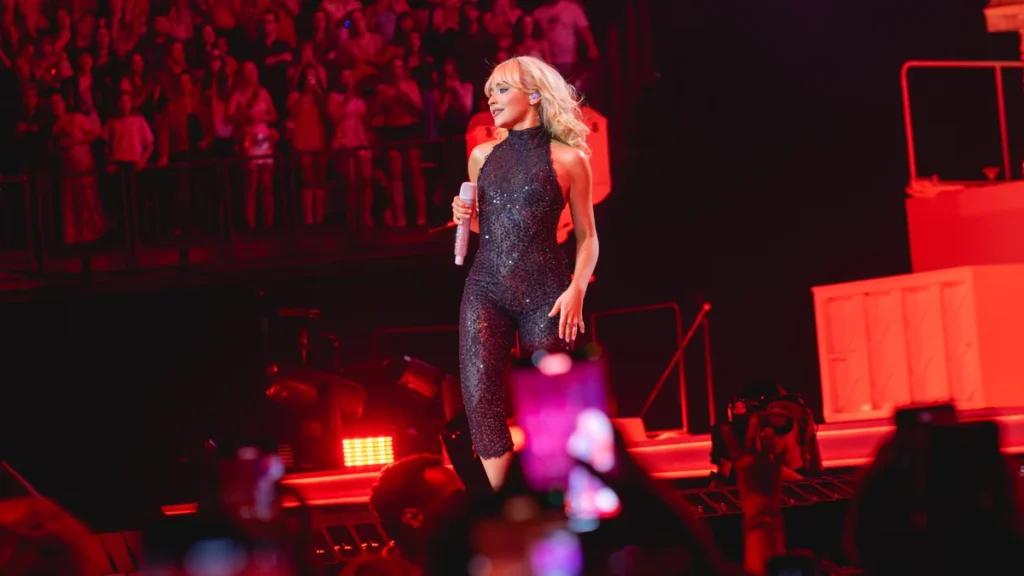
Sabrina Carpenter performing at the O2 Arena in London.

Sabrina Carpenter released a single called "House Tour" in April, eight months after the album it belongs to came out through Island Records.

That gap is the interesting part. Most pop albums have exhausted their singles by month four.

An Eight-Month Gap Between Album and Single

The conventional pop campaign runs two singles before an album, one on release week and perhaps one more within a quarter.

After that the record is expected to have found its audience, and the label moves resources to the next project.

Releasing a new single eight months later means the album is still commercially live, which is unusual and expensive to sustain.

It also means the campaign now spans two calendar years, which changes how the record is counted in year-end summaries and award cycles.

What a Long Campaign Signals

Labels extend campaigns for one reason: the record is still returning more than the next release would.

A pop album that is still generating enough activity in month eight to justify a new single, a video and a promotional push is performing well above the norm.

The alternative reading, that the follow-up is not ready, is less likely for an artist at this level, where release schedules are planned years ahead.

Following a Breakthrough

The album arrived after the record that moved her from a working pop artist to one of the biggest in the world.

That is the hardest position in pop. The previous album's audience arrived through two enormous singles, and it expects the same again.

Releasing the follow-up twelve months later rather than waiting is a deliberate refusal of the usual caution, and it puts the record into a market that has not stopped playing its predecessor.

Island and the Speed of the Cycle

Island Records handled both albums, and the compressed gap between them reflects a label strategy rather than an artistic one.

The reasoning is straightforward. An artist at peak visibility has a window, and waiting three years for the next record means re-establishing rather than continuing.

The risk is that a record made quickly under those conditions is a lesser version of the one before it, which is what usually happens.

A Film Actor in the Video

The video for the single featured Colman Domingo, an actor with substantial film and theatre credits rather than a music-video regular.

Casting serious actors in pop videos has become common, and it works for both parties: the video gains credibility and the actor reaches an audience that does not watch their films.

It also raises the production standard. A video built around a performance rather than a concept needs an actor who can carry it.

The Persona Is the Product

Carpenter's recent work has been built on a specific and consistent comic persona, delivered through the lyrics, the videos and the live show simultaneously.

Pop personas of that kind are difficult to sustain because they are narrow by design, and audiences tire of a joke faster than they tire of a sound.

The counter is that a well-defined persona makes everything else easier: the artwork, the touring, the merchandise and the press all follow from it without further invention.

From Television to Pop

She came up through children's television, which is a well-worn route into pop and one that carries a persistent credibility cost.

Artists from that background spend years being treated as products rather than musicians, regardless of what they release.

The way through it has historically been either a dramatic reinvention or simply outlasting the assumption, and several albums of consistent work is the more reliable of the two.

Arena Touring Behind the Records

The touring cycle has been running at arena scale, including multiple nights at large venues in Europe.

Arena runs at that level are the clearest evidence that an audience is real rather than algorithmic, because tickets require a decision and a payment months in advance.

It also explains why the album campaign has been extended. A record still selling tickets is a record worth promoting.

Album Titles as Provocations

Both recent albums have carried titles designed to be remarked upon rather than simply named.

Pop has increasingly used titles and artwork as the first line of promotion, generating discussion before a note has been heard.

The technique works and has a short half-life. A title that provokes gets attention for a week and then has to be carried by the songs.

Singles Released Long After the Album

The late single has become a recognisable strategy in pop, and it works differently from a deluxe edition.

A deluxe adds tracks to the album and resets its streaming activity. A standalone single released from an existing album directs attention to a specific song that was already there.

That is a cheaper intervention and a more targeted one, since it costs nothing to record and only requires promotion.

The Follow-Up Problem in Numbers

Records following a breakthrough almost always sell less, and the drop is usually attributed to quality when it is mostly attributable to audience composition.

A breakthrough album is bought by a large casual audience assembled by two singles, and casual audiences do not return automatically.

What determines the follow-up's performance is how much of that audience converted into something more durable, which is exactly what an eight-month campaign is designed to measure.

Pop's Compressed Release Clock

The industry standard gap between major pop albums has fallen from three years to roughly eighteen months over the last decade.

Streaming is the cause. Catalogue decays faster, attention moves faster, and an artist absent for three years returns to a market that has replaced them.

The cost is visible in the records. Albums written and recorded inside a touring cycle are made under conditions that do not favour risk.

What Actually Happens to a Casual Audience

The distinction between a casual and a committed audience is the single most useful thing to understand about pop economics, and it is rarely stated plainly.

A breakthrough single reaches an enormous number of people who like the song and have no particular relationship to the artist. They stream it, they hear it in shops and adverts, and when it stops being everywhere they stop thinking about it. That audience is real but it is rented.

A committed audience buys tickets, buys physical product, follows the campaign and shows up for the next record without being persuaded. It is a fraction of the size and worth considerably more per person over a decade.

The entire purpose of a long campaign is conversion: keeping a record in front of the rented audience long enough that some proportion of it becomes the other kind. Eight months of promotion is expensive precisely because the conversion rate is low and the payoff is measured in years.

Why the Comic Register Is Harder Than It Looks

Funny pop is genuinely difficult, and the difficulty is structural rather than a matter of taste.

A joke has a single optimal delivery and diminishing returns on repetition, which is the opposite of what a pop song needs. A record that people play two hundred times cannot depend on a punchline, because the punchline stops working around the fifth listen.

The songs that survive it work on two levels simultaneously: the joke carries the first hearing and something else — a melody, a chord change, an emotional undertow the humour is deflecting — carries the rest. Records built only on the joke disappear inside a year.

That is the real question hanging over a persona this well defined. Not whether the audience finds it funny, but whether the songs underneath would survive if it were removed.

What Is Actually Being Tested

Two things. Whether a comic pop persona can sustain across a third and fourth album, or whether the format has a natural limit.

And whether an eight-month campaign extension indicates genuine durability or a label protecting an investment past the point where the audience has moved on.

One album, eight months, a new single, an actor in the video, and a campaign that refuses to end.

Tate McRae Reached Number One With So Close to What

Tate McRae Reached Number One With So Close to What

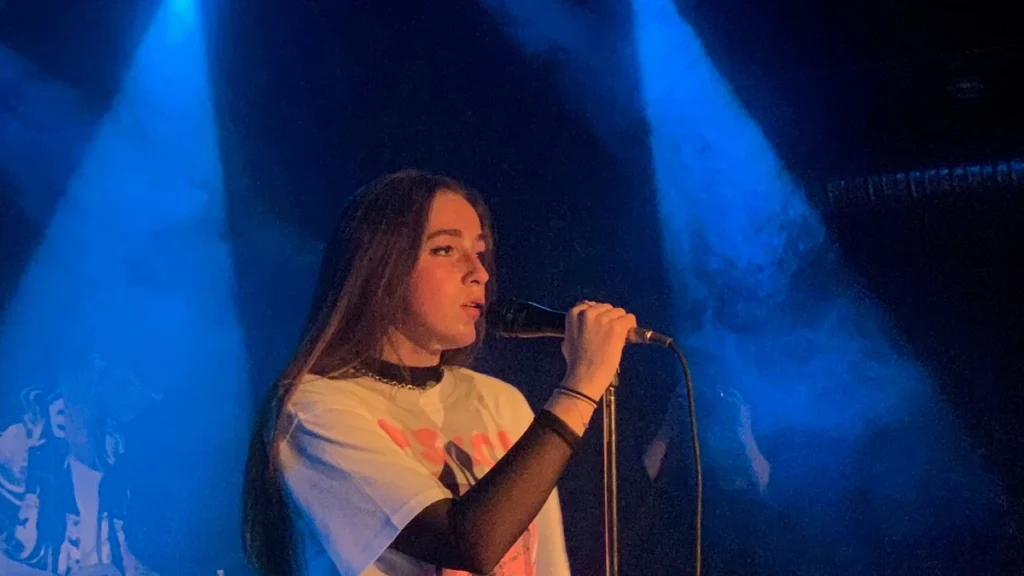
Tate McRae performing in Berlin.

Tate McRae reached number one on the American albums chart for the first time with her third record, which also topped the chart in nine other countries.

It runs a little over forty-two minutes, and a deluxe edition later expanded it to twenty-one songs.

Ten Countries at Number One

Topping the chart simultaneously in Australia, Austria, Canada, Flanders, Ireland, the Netherlands, New Zealand, Norway, Switzerland and the United States is a specific kind of achievement.

It indicates an audience distributed across markets rather than concentrated in one, which is harder to build and considerably more durable.

Artists who chart heavily in a single territory can have very large numbers and a fragile position. An artist charting across ten has ten separate touring markets.

The list is also revealing in what it contains: northern European and Anglophone markets, which is the standard footprint for contemporary dance-pop.

The First Number One

This was her first album to debut at the top in the United States, which is the threshold that changes how an artist is described.

Before a number one, an artist is a successful pop act. Afterwards they are a chart-topping one, and the label follows them permanently.

Reaching it on a third album rather than a first is the more common pattern and generally the healthier one, since it means the audience was built rather than arriving at once.

Forty-Two Minutes

The running time is disciplined for a major pop release, where fifteen tracks and an hour has become close to standard.

Shorter pop albums are increasingly rare precisely because streaming rewards length, and a record that stops after forty-two minutes is leaving chart units on the table.

What it gains is pace. A pop album that does not outstay its welcome gets replayed, and replays are worth more over a year than tracks nobody reaches.

Four Singles Before Release

The singles ran from September 2024 through November, January and March, with the last arriving after the album.

Releasing a fourth single two weeks post-release is a deliberate second wave rather than a preview, aimed at extending the record's first months.

Five months of singles ahead of an album is a long campaign by current standards, and it indicates a label confident enough to invest across a full cycle.

The Deluxe Edition Nine Months Later

A deluxe edition in November 2025 took the album from its original length to twenty-one songs.

The additions included a single that reached the top five in the United States, which is unusual. Deluxe tracks are normally leftovers, and a genuine hit among them suggests the material was withheld rather than discarded.

That is a more interesting version of the format than the standard one, because it means the reissue changed the album's commercial trajectory rather than merely extending it.

Dance-Pop With a Pop-Rock Edge

The record sits across pop, dance-pop, power pop and R&B, which is a wide description and a fair one.

Contemporary pop has largely abandoned genre coherence within an album, and records now move between production styles track to track in a way that would have seemed incoherent twenty years ago.

What holds it together is the voice and the writing rather than the arrangement, which is a shift in how pop albums are constructed.

A Dancer First

McRae came to music through competitive dance, which is unusual and audible in the work.

An artist trained in movement thinks about rhythm physically rather than theoretically, and it shows in phrasing that sits slightly behind or ahead of the beat in ways that feel choreographed.

It also shapes the live show, which is built around performance in a way that most singer-songwriter-derived pop is not.

Calgary Is Not a Pop Centre

She is from Calgary, which has no pop music infrastructure to speak of and no history of producing international pop stars.

That is now largely irrelevant, because an artist can build an audience online before any industry involvement, and she did exactly that.

The geography still matters in one respect: an artist from outside the traditional centres arrives without the network, and the relationships have to be built from scratch.

RCA and the Major-Label Push

The album came through RCA Records, and a chart-topping pop release at this scale requires the full apparatus of a major.

Radio promotion, international coordination, playlist relationships and retail placement all have to happen simultaneously across ten territories.

No independent operation can execute that, which is why pop remains the most major-label-dependent genre in the business.

Third Albums in Pop

The third album is where pop careers are usually decided.

The first establishes an artist, the second tests whether the audience is real, and the third determines whether the career has a ceiling or a trajectory.

Debuting at number one at that point is about the clearest possible answer, and it changes what the fourth album is allowed to be.

What the Title Is Doing

The album title is a fragment rather than a phrase, and the deluxe edition added punctuation that turned it into a question.

That kind of titling is characteristic of current pop, which favours conversational incompleteness over declarative statements.

It reflects the writing too. Contemporary pop lyrics increasingly work in fragments and asides rather than in complete narrative units.

Why Deluxe Editions Keep Working

The reissue arrived nine months after the album, which is the standard interval, and it performed.

The mechanism is simple: new tracks bring listeners back to the whole record, which resets its streaming activity and generates a second chart cycle.

It works reliably enough that most major pop albums now have one planned before the original is released, which is why the format has stopped meaning anything about the music.

An Audience Built Before the Industry

Her early audience came from online video, where she posted original songs before any label was involved.

That route produces a specific relationship between artist and listener, closer to sustained familiarity than to discovery, and it is more durable than a hit-driven audience.

It also means the record company inherited an audience rather than building one, which changes the balance of the deal considerably.

What Simultaneous Number Ones Require

Topping ten national charts in the same week is a logistical achievement as much as a musical one, and it does not happen by accident.

Each territory has its own chart rules, its own streaming market share and its own release-day conventions. Getting an album to peak in all of them at once means the marketing, the radio servicing and the retail stock have to land in the same seven-day window across three continents.

That coordination is one of the few things a major label still does that nobody else can. An independent distributor can place a record everywhere; it cannot run ten simultaneous national campaigns with local staff in each market.

The other requirement is a genuinely portable sound. Records that chart across northern Europe and the Anglosphere tend to share production values that translate without adaptation, which is both why this footprint recurs and why it stops where it does.

When a Deluxe Track Becomes the Hit

The standard deluxe edition adds material the artist already decided was not good enough, which is why almost none of it registers.

A deluxe track that reaches the top five nationally therefore breaks the pattern, and there are only two explanations. Either the song was written after the album and simply did not exist at release, or it was finished and deliberately held.

Holding a hit is a real strategy and a risky one. It gives the campaign a second peak nine months in, at exactly the point when an album would otherwise fade, and it extends the touring cycle by months.

The risk is that the album's own release week is weaker than it could have been, and if the record underperforms there is no second chance to deploy the withheld song. It only looks clever in retrospect.

What Is Actually Being Tested

Two things. Whether an artist who reaches number one on a third album can avoid the fourth-album contraction, which is the point at which most pop careers narrow.

And whether a deluxe edition containing a genuine hit rewrites how the format is used, or whether it stays the routine mechanism it has become.

Ten countries, forty-two minutes, four singles, twenty-one songs by the end, and a first number one arriving exactly where the odds said it should.

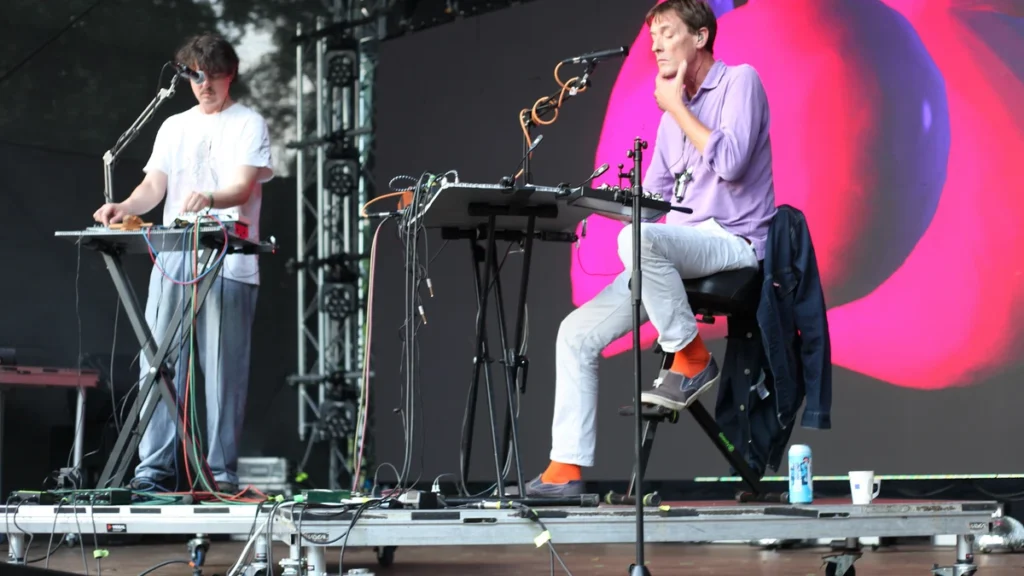
Panda Bear and Sonic Boom performing behind keyboards on a festival stage

Panda Bear Built an Album From Harp Loops and a Mariachi Band

The instrument list on the new Panda Bear and Sonic Boom record reads like a list of things that do not belong together: harp, steel drum, pedal steel, and a mariachi band from Mexico City.

A ? of WHEN arrived on 10 July through Domino, ten tracks long, the follow-up to the duo's 2022 album Reset.

Four Instruments That Should Not Cohere

The press material describes a record "built on loops of harp and sequences of steel drum, webs of pedal steel, and even bits of a mariachi band from Mexico City".

Each of those carries a very strong association. Harp signals the classical concert platform or something deliberately ethereal. Steel drum means the Caribbean, and in most pop contexts means it lazily. Pedal steel means country. A mariachi band means Mexico so unambiguously that using it at all risks sounding like a postcard.

Putting all four on one record is either a mess or a method. The clue that it is the second is the word "loops": these are not guest performances dropped into arrangements but sources being cut into repeating figures, which strips an instrument of its context and leaves only its texture.

That is the technique the duo already used on Reset, which was built on samples of early rock and roll records looped into something that no longer sounded like its source. Applying it to a harp and a mariachi horn section is the same idea aimed at less obvious material.

Real Players, Not Just Samples

The collaborators confirm it is not purely a sample exercise. Noah Lennox and Pete Kember are joined by the harpist Mary Lattimore, the British multi-instrumentalist Daniel O'Sullivan — known for work with Sunn O))) and Ulver — and the steel guitarist Zena Kay.

Lattimore is a significant name in her own right, an experimental harpist whose solo records use effects and looping rather than classical technique. Hiring her is a signal that the harp on this album is meant to sound like her harp rather than like an orchestral one.

O'Sullivan comes from an even further-out tradition — drone metal and Norwegian experimental music — and his presence suggests the record's textures go somewhere darker than the instrument list implies.

That combination of played and looped material is harder to assemble than either alone. A sampled loop is fixed; a live player can be asked to change, and reconciling the two means deciding, repeatedly, which one the track is actually built on.

There is a clearance dimension too. Building an album from samples of existing recordings, as Reset did, means negotiating with rights holders before anything can be released; commissioning musicians to play the material you want to loop removes that constraint entirely.

Recording a mariachi band in Mexico City rather than sampling one from a record is the clearest instance of that. It costs more and takes longer, and it means the parts can be written rather than found.

An Album About Being Tired of the Internet

The subject matter is the deliberate counterweight. Against what the announcement called the more playful sonic output, the pair address "online exhaustion and pervasive depression" alongside "political chicanery and ecological sustainability".

Online exhaustion is a difficult thing to write about without sounding either preachy or dated. It is also, at this point, close to a universal condition, which makes it more like weather than like a topic.

The musical approach may be the point. A record made from looped fragments of unrelated sources is structurally a description of scrolling — disconnected material arriving in sequence, each piece stripped of the context that would explain it.

Whether that reading is intended or imposed, the pairing works: bright, warm, faintly absurd instrumentation carrying lyrics about depletion is a more honest picture of the experience than a bleak arrangement would be. Our piece on what pre-saves and pre-adds actually do covers the machinery on the other side of that fatigue.

Six Weeks From Announcement to Release

The rollout was brief. The album was announced on 27 May with the title track, and released on 10 July — a six-week window, short for a record with this much going on inside it.

Leading with the title track rather than the most immediate song is consistent with the rest. It presents the album as an object with a name and a shape, not as a container for a single.

The title itself resists being typed correctly, which is either a joke about search or an accident. A ? of WHEN contains a punctuation mark and a capitalised word, and it is the kind of title that survives on being recognised rather than looked up.

Domino has released both this and Reset, which gives the collaboration a stable home. A duo project between two established artists frequently ends up on whichever label one of them happens to be signed to; a second album on the same imprint suggests it is treated as a band rather than as a side venture.

Ten tracks is the other decision worth noting. It is short enough to be heard in one pass and long enough to establish a method, which for a record built on unfamiliar combinations is close to the minimum viable length — a listener needs to hear the approach more than once before it stops sounding accidental.

What Each of Them Brings

The partnership is unusual in that both halves have long histories. Lennox has released six solo albums as Panda Bear since 1999, including Person Pitch, Tomboy and Panda Bear Meets the Grim Reaper, the latter two reaching the Billboard 200.

He is also a co-founding member of Animal Collective, who spent most of 2025 marking the twentieth anniversary of Feels — which places this record immediately after a year of looking backwards.

His work outside both projects covers a wide spread: Daft Punk's "Doin' It Right", Dean Blunt's "9", and Braxe + Falcon's "Step by Step". That is a musician who has spent twenty-five years being useful to people making very different records.

Kember's contribution is harder to summarise briefly and easier to hear. His production work has long been defined by treating repetition and drone as the structure rather than the background, which is precisely what a record built on loops of harp requires.

Two albums in, the collaboration has stopped being an experiment. What A ? of WHEN adds is the demonstration that the method works on material with no obvious relationship to each other.

The pairing also solves a problem each of them has separately. A solo Panda Bear record carries the whole weight of a distinctive voice with nothing to push against; a Kember production without a strong singer can drift into pure texture. Together the parts constrain each other.

The touring picture supports that reading. The two have been playing festival stages together through 2026, performing as a duo behind keyboards rather than assembling a band — a live format that matches how the records are built.

What the album does not do is resolve into a single sound. Ten tracks assembled from four unrelated instrumental traditions will never be tidy, and the evidence of Reset is that tidiness was never the objective.

A ? of WHEN is out now on Domino.