Rosalia Recorded Lux With the London Symphony Orchestra

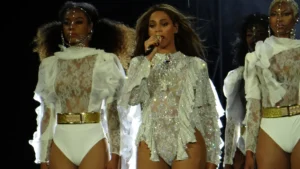
Rosalia performing in Chile.
Rosalia performing in Chile.
Rosalia recorded her fourth studio album with the London Symphony Orchestra, conducted by Daniel Bjarnason, and released it through Columbia Records in November 2025.
It produced the biggest streaming debut ever recorded for a female Spanish-language artist and the strongest commercial opening of her career.
A Full Symphony Orchestra
Using the London Symphony Orchestra on a pop record is a substantial and expensive decision, and it is not the same as adding strings.
A full orchestra requires the music to be scored, which means every part written out for players who read rather than improvise, and a conductor to hold it together.
That changes the composition process fundamentally. Songs have to exist as notation before they exist as recordings, which is the opposite of how pop is normally built.
It also means the arrangements are fixed. An orchestral session is booked by the hour and the parts cannot be reworked in the room the way a small band’s can.
Who Bjarnason Is
Daniel Bjarnason is an Icelandic composer and conductor who works across contemporary classical music and film scoring.
Hiring a working composer rather than a session conductor is a meaningful distinction. A composer conducting somebody else’s material brings a structural ear to it rather than simply executing the score.
His involvement also places the record in a specific contemporary-classical lineage rather than in the older tradition of pop-with-strings.
The Biggest Spanish-Language Debut
The streaming record is the headline figure and it is worth reading carefully.
Spanish is the second most spoken native language in the world, and the Latin American streaming market is enormous, so a Spanish-language record has a very large potential base.
What has historically limited Spanish-language artists is not audience size but industry infrastructure and playlist gatekeeping, both of which have shifted substantially in the last decade.
Forty-Two Arena Shows
The tour runs forty-two arena dates across seventeen countries, opening in Lyon in March and closing in San Juan in September.
That is a full year of touring at arena scale, which is a level very few Spanish-language artists have reached outside the Latin American market.
Seventeen countries is also unusually broad. Most arena tours concentrate on a handful of high-density markets rather than spreading across a continent.
Lyon to San Juan
The routing begins in France and ends in Puerto Rico, which describes the two poles of her audience.
European dates account for the artistic and critical reputation, while the Caribbean and Latin American dates account for the linguistic and commercial base.
Closing in San Juan rather than Madrid or Barcelona is the more interesting choice, and it places the endpoint in the Caribbean rather than in Spain.
Touring an Orchestral Record
The practical difficulty with an orchestral album is that the tour cannot reproduce it.
Carrying a symphony orchestra on a forty-two date arena run is financially impossible, so the material has to be rearranged for a touring ensemble.
That rearrangement is itself a creative act, and it frequently produces a version of the songs that differs substantially from the record.
Four Albums, Four Different Records
Her catalogue has moved deliberately rather than developing incrementally.
The early work drew directly on flamenco, the middle records moved into reggaeton and experimental pop production, and this one moves into orchestral composition.
Very few artists change idiom that completely between records, and fewer still keep an audience while doing it.
Flamenco as a Starting Point
She trained in flamenco, which is a formal tradition with a demanding technical vocabulary and a strong sense of lineage.
Artists who come from a codified tradition and then leave it face specific criticism from within that tradition, and she has received it.
What the training provides is a level of vocal control that pop rarely demands, and it is audible in phrasing that most pop singers could not execute.
Columbia and the Major-Label Bet
Columbia Records released the album, and an orchestral record from a pop artist is exactly the kind of project a major exists to fund.
The costs are substantial: orchestra hire, a conductor, scoring, a large studio and the engineering to record it properly.
No independent operation could absorb that, which is why ambitious orchestral pop is almost always a major-label product.
Spanish-Language Pop’s Position
The last decade has seen Spanish-language music move from a regional category to a central part of the global market.
That shift was driven by streaming, which removed the radio and retail gatekeeping that had kept non-English music in separate charts and separate shops.
An artist singing in Spanish now competes in the same market as one singing in English, which was not true fifteen years ago.
Records That Change Idiom
Albums that abandon an artist’s established sound are the highest-risk move available, and the outcomes cluster at the extremes.
The failures are records where the new idiom is worn rather than understood, and audiences detect the difference immediately.
The successes work because the artist has genuinely learned the new vocabulary, which is a question of preparation rather than ambition.
What an Orchestra Adds
The reason to use an orchestra rather than samples is dynamic range and the specific sound of many players not quite together.
Sampled strings are perfectly in tune and perfectly in time, which is exactly why they sound artificial. A real section has small variations in pitch and attack that produce warmth.
Capturing that requires a room large enough for the ensemble and engineering capable of handling eighty microphones, which is a specialist job.
Where the Fourth Album Sits
Four albums in, with a distinct identity on each, she occupies a position closer to an art-pop artist than a mainstream pop star.
That is a more durable career shape, because an audience that follows an artist through changes is not attached to any single sound.
It also means each record is judged on its own terms rather than against the last one, which is the freedom most pop artists never get.
What Scoring for an Orchestra Actually Involves
The gap between writing a pop song and writing for eighty players is larger than most descriptions suggest, and it is worth spelling out.
A pop arrangement is built by layering: a part is played, kept or discarded, and another added on top until the track feels finished. Nothing needs to be written down, and any element can be changed at any point.
An orchestral score cannot work that way. Every note for every instrument has to exist on paper before the session, transposed correctly for instruments that read in different keys, with bowings for the strings and breathing marks for the winds. Getting it wrong is not a creative problem but a logistical one: eighty people are sitting in a room being paid by the hour.
That is why orchestral pop records are almost always made with a dedicated arranger or composer rather than by the artist alone, and why the choice of who holds that role determines a great deal about how the finished record sounds.
How Streaming Redrew the Language Map
The claim about a Spanish-language streaming record only makes sense against what came before it, and the change happened faster than most people noticed.
Under the old system, language was a hard boundary enforced by infrastructure. Radio formats were monolingual, record shops filed non-English music in a separate section at the back, and charts were segregated by language before anybody counted a single sale.
Streaming removed all three at once. There is no separate shelf, no format clock and no gatekeeper deciding what a station’s audience will tolerate, and the algorithmic surfaces respond to listening behaviour rather than to a programmer’s assumptions about it.
The consequence is that Spanish-language artists now compete for the same attention as English-language ones with the same tools, and the audience turns out to have been considerably larger than the old infrastructure ever allowed anyone to see.
What Is Actually Being Tested
Two things. Whether an orchestral record translates to an arena stage, since the room and the arrangement are working against each other.
And whether an audience assembled across four very different albums holds together, or whether each change has left part of it behind.
A symphony orchestra, an Icelandic conductor, forty-two arenas, seventeen countries, and a fourth album that sounds like none of the first three.
About The Author