This Is Lorelei Wrote His Matador Debut From a Van Window
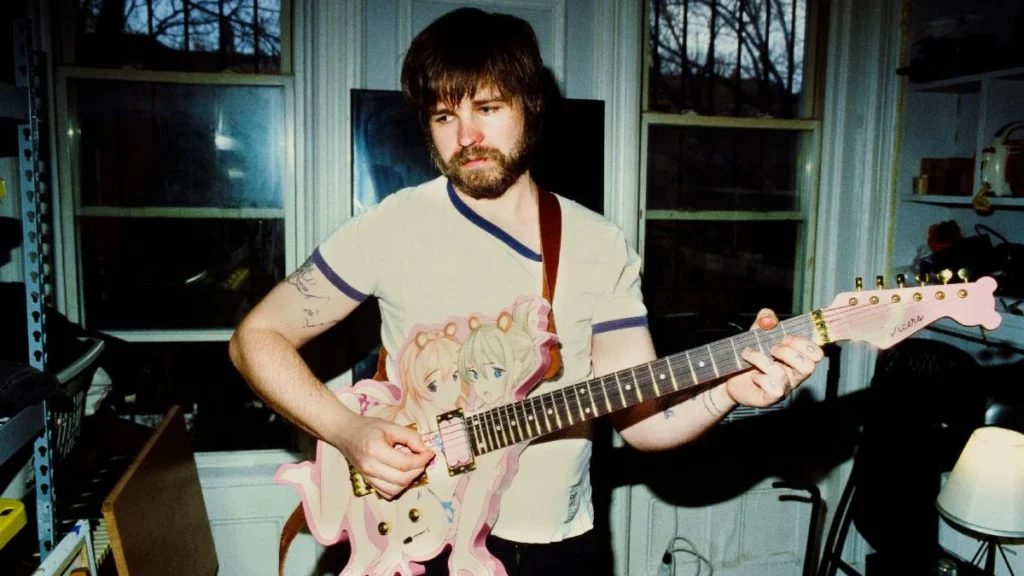
This Is Lorelei releases The Singer in My Band this week, the first album Nate Amos has made for Matador Records. It is for anyone who followed the run of records he has been putting out since 2024 and wondered what happens when the underground songwriter gets a proper label behind him.
The thing worth noting is how it was written. Amos was on tour, with no instrument to hand, and the songs arrived through a van window.
Written Without an Instrument
“The ideas incubated while daydreaming in the car without access to any instruments,” Amos says in Matador’s own notes on the record. “So instead of being home and writing on the guitar or a computer, they developed slowly and subconsciously, existing as a sort of intangible thing while looking out the van window.”
That is a real constraint, not a colour detail. A song written at a guitar tends to be shaped by what the hands can reach. A song assembled in the head has no such limit, and no editing either.
Matador calls it the first true road record in his discography. It was written while touring in support of releases from both of his projects, which is a lot of van.
What He Is Building On
Amos plays in Water From Your Eyes and runs This Is Lorelei on his own. In 2024 he signed the solo project to Double Double Whammy and released Box For Buddy, Box For Star.
That record did more than land well. Stereogum described it as having emerged as one of the defining indie rock albums of this decade, and noted the growing recognition of Amos as a singular songwriter.
Last year he re-recorded a batch of old songs as Holo Boy. Before any of that, This Is Lorelei was known only to a small circle in Chicago, where Amos moved in his early twenties and produced hundreds of albums and EPs before relocating to New York.
Other Artists Keep Covering Him
The clearest measure of where he stands is who has recorded his songs. MJ Lenderman, Hayley Williams, Jeff Tweedy and Cameron Winter have all covered his material, and Waxahatchee and Snail Mail joined the run of Box For Buddy covers issued across deluxe editions.
That is an unusual list for someone at this stage. Covers from established artists usually follow commercial success; here they arrived alongside it, and in some cases ahead of it.
It also tells you something about the songs themselves. Material that survives being sung by four very different voices is material with structure underneath it, not just a performance.
He Made It Himself, With His Family on It
Amos engineered, produced and performed everything on the record. The exceptions are all family: banjo from his father, the bluegrass musician Bob Amos, and vocals from his sister Sarah Amos and his partner Al Nardo.
“They’re three people who had a fundamental impact on what this album was to begin with,” he told The Line of Best Fit when the album was detailed in June.
Banjo from a bluegrass parent is not a decorative credit on a record framed around the Great American Songbook. It is the actual lineage, played by someone who plays it for a living.
Lead single “Billy Came Back” arrived with the announcement, and Amos described its writing in terms that match the van-window method exactly. “‘Billy Came Back’ stewed for months before I picked up a guitar to work it out,” he said. “I kept forgetting about it but it always came back. Finishing the song was the only way to get it to leave me alone.”
That is the same filter described earlier, stated from the inside. The song was not written down and worked on; it was carried until it refused to be ignored. On a record made this way, the surviving material has already passed a test most demos never face.
The Songbook Reference Is Doing Real Work
Matador frames the record as taking the building blocks of the Great American Songbook and twisting them into new shapes, describing the result as at once strangely familiar and endearingly offbeat.
Read that alongside the writing method and it makes sense. Standards are the most portable songs ever written: melody and chord movement that survive being hummed, transposed and rearranged, because they were built to be played by anyone. They are exactly the kind of song you can carry in your head across a continent.
A record written without an instrument almost has to lean that way. Whatever cannot be remembered does not make it into the song, which is a harsh filter and a useful one.
Formats and Release
The record is out this week, with Matador listing orders arriving around 11 September. It comes on bone white vinyl and standard black vinyl, both at under twenty-six dollars, and on CD at under fourteen. LP orders include a bumper sticker while supplies last, and there is a T-shirt bundle.
The two vinyl variants are worth a note for anyone who cares. Colour-variant pressings on an indie label usually sell out first and do not return, so the choice is effectively made in the first week or not at all.
For a first album on a new label, that is a straightforward release: three formats, no deluxe edition, no staggered rollout. The record is the product.
Three Records in Three Years
The release rate is worth stating plainly, because it is unusual for a songwriter at this level of attention. Box For Buddy, Box For Star in 2024, Holo Boy in 2025 pulling songs from his back catalogue, and now The Singer in My Band, alongside continuing work with Water From Your Eyes.
Most artists slow down after a record lands the way the 2024 album did. The standard advice is to protect the moment, tour it for eighteen months and take time over the follow-up.
Amos did roughly the opposite, and the Chicago years explain why. Someone who produced hundreds of releases before anyone was listening does not experience a two-year gap as caution; he experiences it as a stoppage. The pace here is the normal pace, and the attention is the new part.
That also reframes the deluxe editions. Two expanded versions of the 2024 album, carrying covers by other artists, kept that record in circulation while this one was being carried around in a van. It is an efficient way to stay present without releasing filler, and it is the sort of move a prolific catalogue makes possible.
What the Label Move Actually Changes
Double Double Whammy to Matador is a real step up in reach rather than in prestige. Both are respected; only one has the distribution to put a record in shops on three continents in the same week.
Amos has already played sold-out shows across multiple continents, so the audience exists. What a larger label supplies is the ability to serve that audience physically, at the moment the record comes out, rather than by mail order six weeks later.
The risk of the move is the familiar one. A songwriter who produced hundreds of releases in Chicago on his own terms now has a release schedule and a marketing calendar. On the evidence of the writing method, that has not reached the songs yet.
What to Play First
Start with the title track, because a record named after one of its songs is usually telling you where its argument sits. Then work outward.
If you are new to Amos entirely, Box For Buddy, Box For Star is the sensible entry point and the reason anyone is paying attention to this one. If you already know that record, the question here is whether songs assembled in transit hold together differently from songs built at a desk. Two years of van windows is a strange way to make an album, and it is the most interesting thing about this one.
Songwriters who take the long route to a first proper platform tend to arrive with more finished than anyone expects, as with Marco Margna, who spent twenty years on other people’s records before I Say No to You.
The Singer in My Band is out this week on Matador Records.
About The Author