Kamasi Washington Marked a Coltrane and Miles Centenary
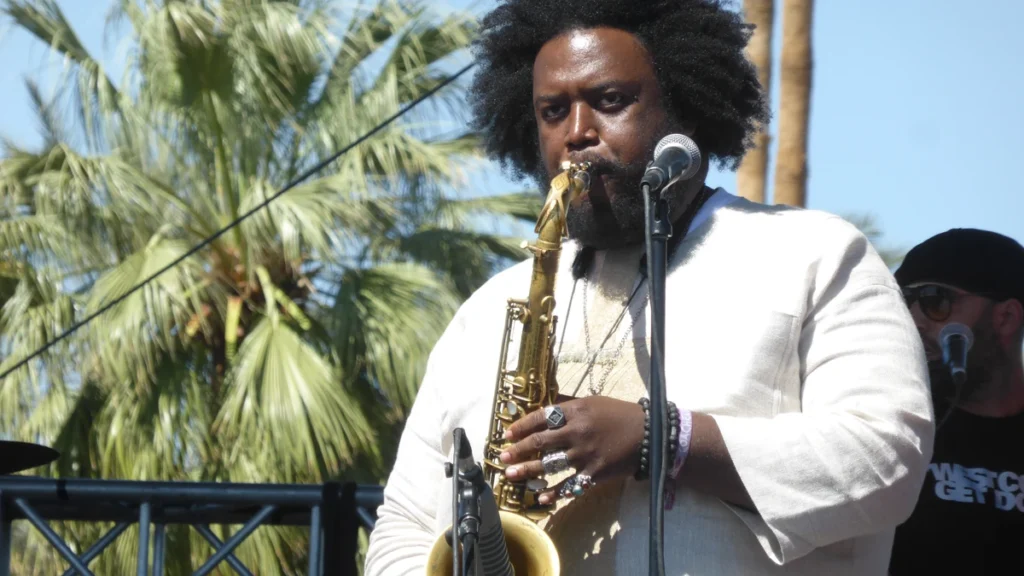
Kamasi Washington performing at Coachella.
Kamasi Washington performing at Coachella.
Kamasi Washington headlined a set at the Newport Jazz Festival marking a hundred years of John Coltrane and Miles Davis, performing alongside Chief Adjuah.
Both men were born in 1926, which is why the festival circuit spent this summer building programmes around the coincidence.
Two Centenaries in One Year
Anniversary programming is a permanent feature of jazz festivals, and a year containing two centenaries of this size is unusual.
Coltrane and Davis are the two figures whose names carry furthest outside the music, which makes them the obvious anchor for any programme aimed at a general audience.
They also worked together, which allows a single event to cover both without the programme feeling like two unrelated tributes stapled together.
The risk in this kind of programming is reverence. A centenary set can very easily become a museum exhibit with a rhythm section.
Why He Is the Right Person for It
Washington is the most visible saxophonist of his generation and one of very few jazz musicians with an audience outside the form.
That visibility came from work adjacent to jazz as much as from jazz itself, including arrangements on one of the most significant rap albums of the last decade.
An artist who reaches listeners who do not otherwise attend jazz concerts is precisely who a festival wants fronting a centenary, because the point is to bring people in rather than to reassure the people already there.
Chief Adjuah Alongside Him
Chief Adjuah performed with him, which is a pairing that says something about the intended approach.
Adjuah is a trumpeter who has moved progressively away from conventional jazz instrumentation and toward instruments of his own design and West African and Indigenous traditions.
Putting a saxophonist and a trumpeter together for a Coltrane and Davis programme is the obvious structural choice, but pairing two musicians who both work outside the tradition signals interpretation rather than recreation.
Fort Adams and the Newport History
The festival runs at Fort Adams State Park in Rhode Island, and its history is genuinely foundational.
Newport was among the first jazz festivals anywhere and has hosted performances that changed careers, including some of the most documented live recordings in the music.
Playing a centenary set there attaches a performance to that lineage automatically, which is part of what the booking is buying.
Montreal Earlier in the Summer
He also returned to the main stage at the Montreal Jazz Festival, which ran from 25 June to 4 July.
Montreal is the largest jazz festival in the world by attendance, and its main stage is free and outdoors, which produces audiences in the tens of thousands.
That festival also premiered previously unreleased Coltrane recordings this year, which places both appearances inside the same anniversary programming.
Unreleased Recordings as Programming
Presenting previously unheard archival material is a recurring feature of anniversary years, and the supply is not accidental.
Recordings sit unreleased for decades for legal, commercial and archival reasons, and an anniversary provides the commercial justification to resolve those problems.
It also raises a question the field has never fully settled: whether releasing material an artist chose not to release serves the music or only the estate.
The Los Angeles Scene He Came From
Washington emerged from a Los Angeles collective of musicians who came up together and have appeared across each other’s records for two decades.
That collective structure is unusual and it explains a great deal about the sound: large ensembles, multiple soloists and arrangements built for a group that already knows how to play together.
It also produced a genuinely local scene at a point when jazz was assumed to be centred elsewhere.
Large Ensembles Are Expensive
His records and live shows use ensembles far larger than the standard jazz quartet or quintet, frequently including choir and strings.
That is a substantial financial commitment. Every additional player is another fee, another flight and another hotel room, and festival budgets are fixed.
Artists who tour at that scale can only do so with a draw large enough to justify it, which is why so few jazz musicians attempt it.
What Anniversary Sets Get Wrong
The failure mode is well understood: a tribute becomes a note-for-note recreation, which honours the recording rather than the musician.
Both Coltrane and Davis spent their careers refusing to repeat themselves, and a set that reproduces their records exactly is doing the opposite of what they did.
The alternative is to play in their spirit rather than their notes, which is harder to execute and considerably easier to get wrong in the other direction.
Miles Davis and the Refusal to Settle
Davis changed idiom repeatedly across four decades, moving through bebop, cool, modal, and electric fusion, and losing part of his audience at every turn.
That trajectory is the reason his centenary is difficult to programme. There is no single Miles Davis to celebrate.
Any set has to choose a period, and whichever it chooses will be the wrong one for a substantial part of the room.
Coltrane’s Later Work Is the Harder Half
Coltrane’s late recordings moved into free playing that remains divisive nearly sixty years later.
A centenary programme can stay with the well-known modal period and satisfy everyone, or engage with the later work and satisfy fewer people more deeply.
Musicians who came up on the later material tend to make the second choice, which is where the interest in a set like this lies.
Jazz Festivals as the Genre’s Infrastructure
The festival circuit is now the primary economic support for jazz at every level, from local players to international headliners.
Club residencies have declined, recorded income is minimal for all but a handful of artists, and the summer circuit is where the year’s income is concentrated.
That gives festival programmers unusual influence over what gets played, which is why anniversary years shape so much of a season.
Reaching Outside the Form
The recurring argument about Washington is whether his crossover audience is good for jazz or a dilution of it.
The argument is old and usually unproductive. Every generation has an artist accused of the same thing, and the accusation says more about the accusers than the music.
What is measurable is attendance. Festivals booking him report audiences who do not attend other jazz events, which is the only outcome the field can afford to want.
What the Two Men Actually Shared
Pairing them in one programme is more defensible than most double tributes, because the connection is direct rather than thematic.
Coltrane played in Davis’s quintet during the second half of the 1950s, and the recordings from that period are among the most studied in the music. He arrived as a technically formidable but stylistically unsettled player and left having found the language he spent the next decade extending.
Davis, characteristically, had moved on by the time Coltrane’s own major work appeared, and the two careers then ran in parallel rather than together. Both kept changing; neither changed in the same direction.
A centenary set therefore has a genuine narrative available: two musicians who overlapped at a specific moment, learned from each other, and then spent their remaining years proving they had learned different things.
What Happens to a Tribute Without Its Subjects
The practical difficulty in this kind of programming is that the audience contains two groups with incompatible expectations.
One arrives wanting recognition. They know the recordings, they know the solos, and a set that departs too far from the source reads to them as a missed opportunity dressed up as interpretation.
The other arrives wanting to hear what living musicians make of the material, and for them a faithful recreation is pointless: the original recordings exist and are better played.
There is no arrangement that satisfies both completely, which is why the best anniversary sets tend to pick one audience and commit. Trying to split the difference produces a performance that is neither faithful enough nor free enough to be worth attending.
What Is Actually Being Tested
Two things. Whether a centenary set can interpret rather than reproduce, which is the difference between a performance and a re-enactment.
And whether the anniversary programming that shaped this summer leaves anything behind once the year ends, or whether it simply resets to the standard circuit in January.
Two men born in 1926, a fort in Rhode Island, a saxophonist and a trumpeter, and a set that had to decide which decade to play.
About The Author