ASAP Rocky Put Doechii and Punk Rock on the Same Album
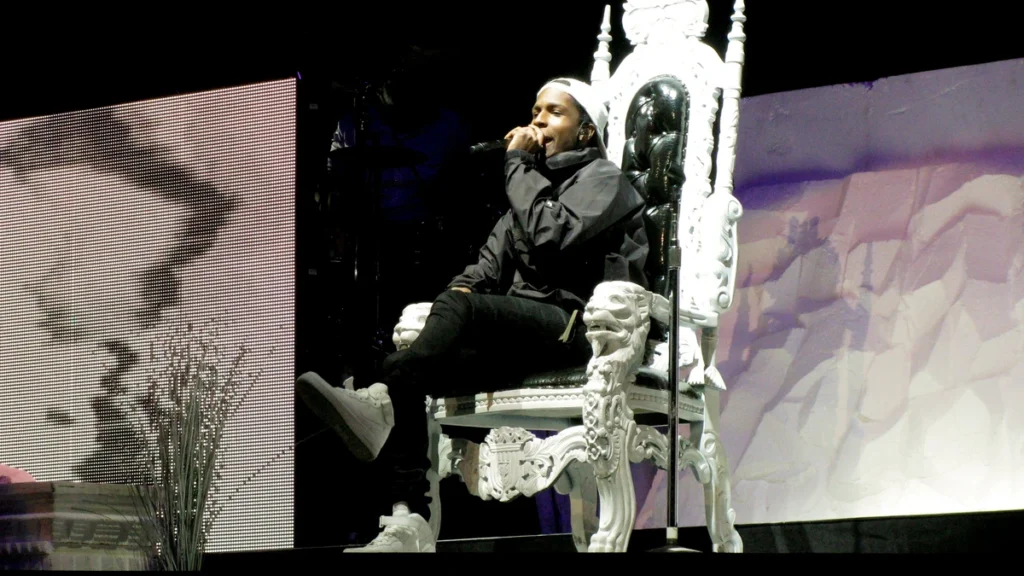
ASAP Rocky performing live.
ASAP Rocky performing live.
ASAP Rocky released Don’t Be Dumb in January, his fourth studio album and his first in almost eight years, and it went straight to number one.
It contains a track built on punk rock and another with a jazz inflection featuring Doechii, which is a fair summary of how the record behaves.
Eight Years Between Albums
The gap since the previous record is the first fact worth stating, because eight years is long enough for a rap audience to turn over almost completely.
Rocky was not inactive in that period. He remained a significant public figure, worked in fashion and film, and released singles, but the album did not arrive.
Albums announced and delayed for years accumulate a specific kind of expectation, and most of them buckle under it.
Debuting at number one after that gap is the clearest possible evidence that the audience stayed, which is not the usual outcome.
A Number One After a Decade
The album topped the Billboard 200, his first chart-topping debut in over ten years.
Chart-topping debuts in rap have become both easier and harder: easier because album-equivalent units count streams, harder because the competition is constant and release weeks are crowded.
An eight-year gap producing a number one indicates a concentrated audience that had been waiting rather than a gradually assembled one.
The Guest List Is Genuinely Strange
The features run from BossMan Dlow and Sauce Walka to Jessica Pratt and Imogen Heap, taking in Brent Faiyaz, Westside Gunn, Doechii, Gorillaz and will.i.am along the way.
That is not a coherent list by any conventional logic, and it is not meant to be.
Street rap, boom-bap revivalism, folk songwriting, electronic pop and a virtual band do not share an audience, which means the album is asking listeners to follow it across several unrelated worlds.
Digital editions add further names again, which extends the same principle rather than resolving it.
Jessica Pratt Is the Surprising One
Of all the guests, the folk singer is the least expected and probably the most revealing.
Her music is quiet, guitar-based and deliberately unadorned, sitting about as far from mainstream rap production as it is possible to get.
Including her signals that the album’s interest in other genres is not decorative. A rapper who wanted a texture would sample something; one who wants the artist has a different intention.
A Punk Track and a Jazz Track
The two most discussed tracks pull in opposite directions: one built on punk rock, the other carrying a jazz influence and featuring Doechii.
Rap has borrowed from both before, but rarely on the same record and rarely with this much commitment.
The risk in genre-spanning albums is that they become sampler platters, where each track demonstrates a capability rather than saying anything.
Tim Burton Did the Artwork
The cover art and the promotional video rollout were designed by the film director Tim Burton, which is an unusual credit on a rap album.
Visual identity has become a substantial part of how records are marketed, and hiring a director with an instantly recognisable aesthetic is a way of buying attention before anyone hears the music.
It also fits Rocky’s established practice. He has worked consistently across fashion and visual art, and treats the presentation as part of the work rather than as packaging.
Three Singles in Four Weeks
“Punk Rocky” arrived on 5 January, “Helicopter” on 12 January, and the album on the sixteenth, with a further single going to radio in February.
Releasing two singles in the eleven days before an album is a compressed rollout, and it is now common practice.
The logic is that the singles function as a countdown rather than as a campaign, keeping the artist in circulation during the week the album actually lands.
AWGE and the Label Structure
The album came out through AWGE and A$AP Worldwide with RCA Records, which is the standard imprint-plus-major arrangement.
AWGE is Rocky’s own creative collective, operating across music, video, design and fashion rather than as a conventional label.
That breadth explains the Burton collaboration and the visual rollout. An operation built to make things other than records will use a record as an occasion to make them.
Where the Third Album Left Things
The previous album was itself a departure, experimental and divisive, and it split the audience at the time.
Following an experimental record with a longer gap and then another experimental record is a consistent position rather than a retreat.
Artists who take that route generally accept a smaller commercial ceiling in exchange for a longer creative runway, though the number one suggests that trade-off did not apply here.
Harlem and the Original Context
Rocky emerged from Harlem in the early 2010s with a sound that combined New York rap identity with Houston-derived production textures.
That combination was unusual at the time and became widely influential, to the point where its origins are now easy to miss.
The genre-crossing on the new album is a continuation of that instinct rather than a new one. The method has stayed constant while the sources have widened.
Rap’s Long-Gap Economics
Eight years between albums is only survivable for an artist with income from outside recorded music.
Fashion partnerships, film, touring and endorsements can sustain a career indefinitely without a release, which is why the gap did not damage his standing.
The corollary is that when the album finally arrives it does not have to perform commercially in the way a working rapper’s record does, which is precisely the freedom that produces an album with a folk singer on it.
Why Genre Tourism Usually Fails
Rappers reaching into rock and jazz have a mixed history, and the failures share a common cause.
The unsuccessful version treats the other genre as a costume, borrowing its most recognisable surface features without changing anything structural about the song.
The successful version changes the writing to suit the form, which means accepting that a punk song needs different phrasing from a rap verse and a jazz-inflected track needs different rhythmic placement.
What a Number One Debut Now Means
A chart-topping debut is worth less than it once was and still worth something.
Streaming makes the first week heavily front-loaded, so a number one increasingly measures the size of an existing audience rather than the reach of a record.
For an artist returning after eight years, that is exactly the useful measurement. It says the audience did not disperse.
What a Deluxe Edition Adds and Costs
Digital editions of the album carry further guests again, which is now standard practice and worth examining rather than accepting.
The commercial reason is straightforward. A second version released weeks after the first resets the album’s streaming activity, generates a fresh news cycle and adds another chart week, all without recording a new record.
The artistic cost is that the album stops having a fixed shape. A record with three different tracklists depending on when and where you heard it cannot be sequenced meaningfully, because there is no canonical order for a listener to experience.
Whether that matters depends on whether the album was designed as a sequence in the first place. For a record that already spans four genres and a dozen guests, the additions arguably change less than they would elsewhere.
Fashion, Film and the Rapper as Operator
The eight-year gap makes more sense once the rest of the activity is accounted for, and it describes a career shape that barely existed twenty years ago.
Artists at this level now run creative operations rather than release schedules. Design work, brand partnerships, directing, curation and touring can each generate income comparable to a successful album, and none of them require a new record to sustain.
That changes what an album is for. It stops being the engine of the career and becomes an occasion within it: the thing that focuses everything else for a period and gives the other work a centre.
The practical consequence is visible in the record itself. An album that does not need to recoup can afford a folk singer, a punk track and a film director on the artwork, because none of those decisions has to be defended to anybody.
What Is Actually Being Tested
Two things. Whether an album that moves between punk, jazz, folk and street rap holds together as one record or reads as a series of experiments.
And whether an artist who can afford not to release albums keeps releasing them, which is a question about motivation rather than ability.
Eight years, four albums, a number one debut, a film director on the artwork, and a guest list that does not make sense on paper.
About The Author