Brian Tyler Built the Mario Galaxy Score From Game Themes
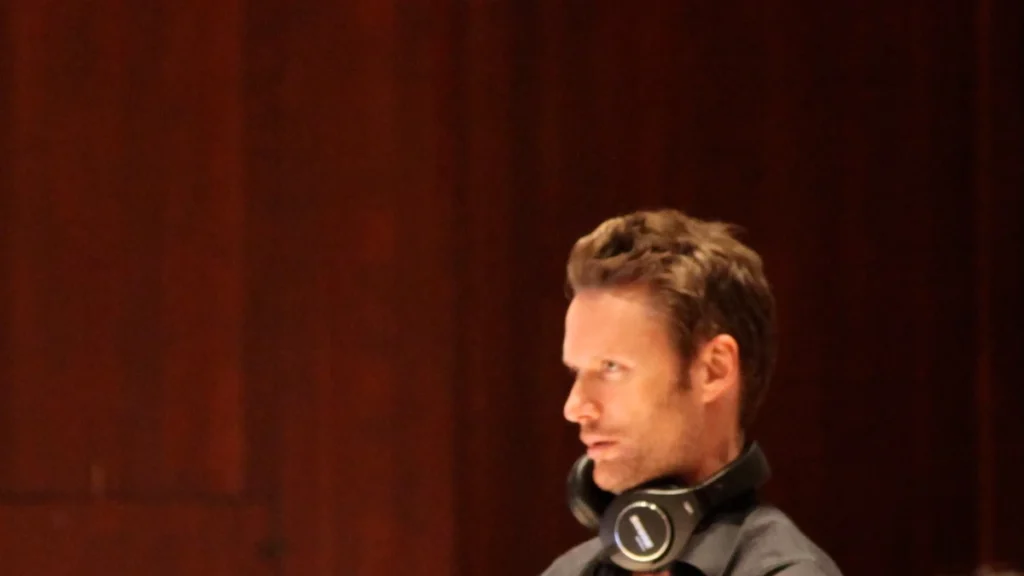
Brian Tyler at a scoring session.
Brian Tyler at a scoring session.
Brian Tyler built the score for this year’s Mario film almost entirely from music written for the games rather than composing it fresh.
The composer of that original music returned as consultant.
Adapting Rather Than Composing
The distinction matters, because a score assembled from existing themes is a different job from writing one.
What it involves is arrangement, development and structure: taking material written in short loops for interactive play and turning it into music that follows a narrative.
Game themes are built to repeat indefinitely without becoming irritating, which is close to the opposite of what a film cue needs.
Converting one into the other requires deciding where a loop becomes a phrase, and what happens when it has to end.
Why Game Music Loops
The structural difference is worth stating plainly, because it explains most of the adaptation problem.
A player might spend forty seconds in a level or forty minutes, and the music has to work for both. That forces composition into cycles with no natural ending and no dramatic arc.
Film music has the opposite constraint: a cue lasts exactly as long as the scene and must arrive somewhere by the end of it.
The Original Composer as Consultant
Koji Kondo, who wrote much of the source material, returned in a consulting role rather than as co-composer.
That arrangement is unusual and it says something about how the material is regarded, since the themes are treated as a repertoire with an author rather than as assets to be licensed.
Consultants on scores have limited formal authority and considerable practical influence, since a note from the person who wrote the tune is difficult to ignore.
Two Decades of Source Material
The album draws on themes from the two Super Mario Galaxy games and from other titles in the series.
Those games are themselves notable for their music, having used a live orchestra at a point when the platform was not expected to support one.
Adapting orchestral game music for an orchestral film score is therefore less of a translation than it sounds, since the material was already written for those forces.
Themes From Another Series
Material from the Star Fox series also appears, which is a crossover most of the audience will notice immediately.
Nintendo’s catalogue functions as a shared musical universe in a way few franchises manage, with themes that carry recognition across unrelated titles.
Using one series’ music inside another film is a fan-facing decision that costs nothing musically and returns a great deal in the room.
Twenty-Four Tracks
The album runs to twenty-four tracks and roughly eighty-seven minutes, which is long for a film soundtrack.
Animated features tend to be wall-to-wall scored, with very few unscored minutes, which produces far more music than a live-action film of the same length.
That makes the album closer to a complete score release than the selective ones most films get.
Two Labels on the Release
The soundtrack came out through a studio label alongside a specialist reissue house, which is an unusual pairing.
The specialist partner brings physical formats and the audience that buys them, which for game music is substantial and not served by streaming alone.
That partnership reflects a market in which game and game-adjacent music sells physical copies at rates most film scores no longer reach.
Returning From the Previous Film
He also scored the previous film in the series, which gives this one continuity most franchises do not manage.
Studios routinely change composers between instalments, usually because of scheduling rather than dissatisfaction, and the results are audibly inconsistent.
Keeping the same composer allows themes established in one film to be developed rather than restated in the next.
Less Licensed Music This Time
Reviewers noted that this film leans far more heavily on the game music than its predecessor, which used a substantial amount of licensed pop.
Licensed songs in family films are a marketing device as much as a creative one, since a recognisable track sells a trailer.
Reducing them in favour of the source material is a decision to trust the audience’s attachment to the games, which is a reasonable bet with this particular property.
Writing It From Hospital
Tyler has said in an interview that he wrote most of the score from hospital after a health emergency during production.
Film scoring schedules are unforgiving and largely immovable, since a release date is fixed long before the music is written.
What that produces is a profession where working through circumstances that would stop most jobs is treated as normal, which is worth noticing rather than admiring.
Game Music as a Repertoire
Music written for games is increasingly treated as a body of work rather than as a functional component.
Concert tours of game scores sell out large halls, the albums chart, and a generation of listeners has the same relationship to these themes that earlier ones had to film music.
Adapting them for cinema is the point at which that repertoire enters a form with more cultural prestige, which is a transfer that has happened before in the other direction.
Nintendo and the Melody
The specific reason this material adapts well is that it is melodic in a way most contemporary scoring is not.
Game music from that era had to be memorable on limited hardware, which forced composers to write actual tunes rather than textures.
Themes built that way survive orchestration, reharmonisation and tempo changes, because there is something underneath to hold on to.
The Constraint of Recognition
An adaptation score carries a burden an original score does not, which is that the audience already knows the material.
Deviating too far produces complaints from the people most likely to buy a ticket, and staying too close produces music that could have been taken directly from the game.
The workable position is usually to state the theme recognisably early and then develop it, which gives both audiences what they came for in sequence rather than in competition.
Orchestrating a Loop
The technical work involved in this kind of score deserves more description than it usually gets.
A game theme arrives as a fixed arrangement, frequently sixteen or thirty-two bars, designed to be seamless at the join. The first task is deciding which four bars actually carry the identity, because that fragment is what the audience recognises.
Everything else can then be rebuilt. The fragment becomes a motif that can be stated by a solo instrument, buried in an inner voice, inverted under a dramatic scene, or brought back in full at the end.
Done well, an audience hears a familiar tune three or four times without noticing that only one of those was the original arrangement. Done badly, it is a medley.
Why Studios Hire the Same Composer Twice
Franchise continuity in scoring is worth more than studios historically believed.
A returning composer arrives with the thematic material already established, meaning the second film can begin developing ideas rather than introducing them, which is a genuine saving in a compressed schedule.
It also protects the property. Themes are among the most durable assets a franchise has, and handing them to a new composer every three years erodes them.
The counter-argument is stagnation, and it is real. Series that keep one composer across five films frequently sound like it by the fourth.
What Is Actually Being Tested
Two things. Whether a score built from existing themes counts as composition or as arrangement, which is a question the credits do not settle.
And whether treating game music as a repertoire worth adapting properly, rather than as nostalgia to be quoted, produces a better film score.
Twenty-four tracks, two decades of source material, one consultant who wrote most of it, and eighty-seven minutes of music.
About The Author