Ashley McBryde Recorded Wild Live With Her Touring Band
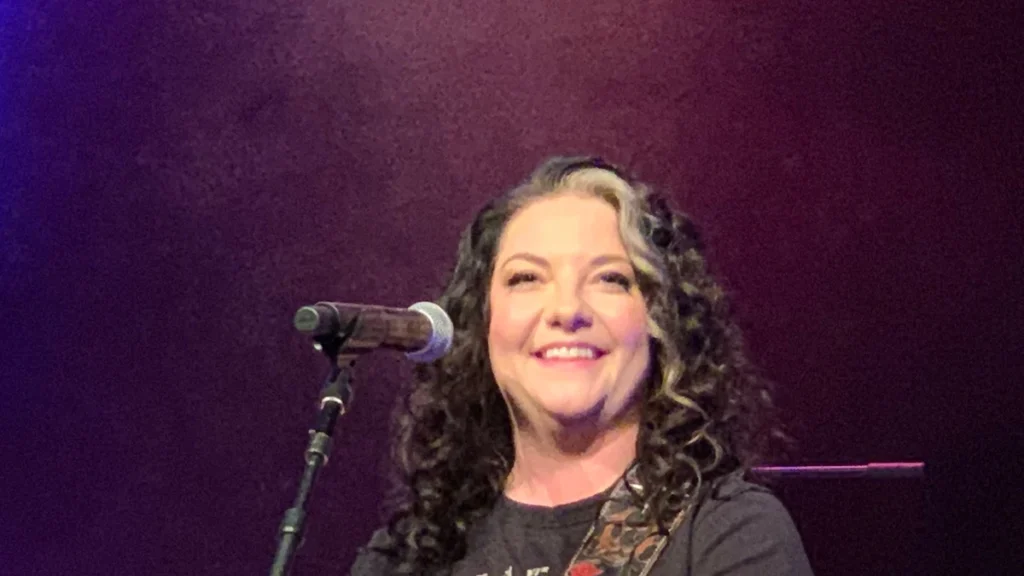
Ashley McBryde performing on stage.
Ashley McBryde performing on stage.
Ashley McBryde made her fifth album with the band she tours with, recorded live rather than assembled from session players.
Twenty-six dates behind it open in Kentucky in September.
Recording With the Band You Already Have
The decision to record with a touring band is a bigger departure in Nashville than it would be almost anywhere else.
The city’s studio system is built on a small pool of session musicians who play on an enormous share of what comes out of it, and they are extraordinarily good at it.
What they cannot do is know how a song has changed across two hundred nights on the road, because they were not there for any of them.
A band that has played the material live arrives with arrangements that have already been tested in front of people, which is a different starting point entirely.
What Live Recording Actually Means
Recording live means the players are in a room at the same time, and the take is the performance rather than a foundation for one.
The modern default is the opposite: a drum take, then bass, then guitars, then vocals, each recorded separately and each fixable in isolation.
That method produces clean records and removes the thing that makes a band a band, which is four or five people responding to each other in real time.
The Cost of Playing It Live
The trade-off is that mistakes are collective. A bad note in the third verse means the whole take goes, not just one player’s part.
That requires either a great deal of studio time or a band that can genuinely play, and studio time is the expensive one.
Bands who have spent years on the road are the only groups for whom this is cheaper rather than dearer, which is precisely why the approach is tied to touring.
Who Produced It
John Osborne produced the record, which is a choice with an obvious logic behind it.
He is a working guitarist in a touring band rather than a career producer, and musicians who still play for a living tend to make different decisions in a control room.
The most common of those is a tolerance for imperfection, on the grounds that a slightly ragged take with the right feel beats a clean one without it.
The Lead Single at Radio
The first single went to country radio in February, three months ahead of the album.
Country radio remains genuinely important in a way it no longer is for most genres, with a formal add process and a chart that takes months to climb.
That lag is why country singles are released so far ahead of albums: the record has to arrive while the single is still ascending, not after it has peaked.
Naming the Band
The touring band has a name of its own, which is a small thing that signals something larger.
Most solo artists’ bands are billed generically, if at all, and the players are interchangeable by design.
Giving a group a name makes replacing a member a visible event rather than an administrative one, and that is usually the intention.
Twenty-Six Dates in Old Theatres
The tour opens on 10 September at the Paramount Theater in Ashland, Kentucky, and runs through venues of a similar kind.
The Louisville Palace, the Alabama Theatre in Birmingham and the Robinson Center in Little Rock are all restored buildings from the first half of the last century.
They seat between one and three thousand, they were built for acoustic performance before amplification, and they sound better than anything built since.
Why the Routing Avoids the Obvious
Ashland, Walhalla and Goldsboro are not cities that appear on most national tours.
Routing through them is a decision about where the audience lives rather than where the industry pays attention, and it is a decision country artists make more often than others.
The rooms are smaller, but they sell out, and an audience in a town that rarely gets a headline tour behaves differently from one in a city that gets forty a month.
Little Rock and the Home State
The Little Rock date is a home-state show, since she grew up in Arkansas.
Those nights carry a different weight, and performers generally describe them as the hardest of a run rather than the easiest.
The audience contains people who knew you before any of this, which removes the distance that makes performing possible.
Finishing in Anaheim
The run closes on 1 December in Anaheim, which is about as far from the opening night as the routing could put it.
Country tours have played Southern California reliably for decades, despite a persistent assumption that the audience is regional.
Finishing on the West Coast in December is also a weather decision, since the alternative is a December date somewhere that might be under snow.
A Fifth Album and What That Means
Five studio albums is the point at which a catalogue starts constraining a set list.
An artist with five records has more material than a ninety-minute show can hold, which means every new album displaces songs the audience came to hear.
That is a good problem, and it is the first one that cannot be solved by working harder.
Theatres Versus Sheds
The choice of seated theatres rather than outdoor amphitheatres is a decision about what kind of evening this is.
Amphitheatres hold far more people and sell far more beer, and the back half of the audience is at a picnic rather than a concert.
A seated theatre puts everyone in a chair facing forward, which suits material that depends on the words being audible.
Songs Built to Be Heard
Her writing is narrative and detail-driven, which places specific demands on a room.
A song that turns on one line in the third verse fails completely if that line is lost, and there is no way to compensate for it with the arrangement.
Choosing venues where the lyric survives is therefore not a preference but a requirement of the material.
What a Touring Band Learns That a Session Player Cannot
The gap between the two is easiest to see in what happens to a song over a year of playing it.
Tempos settle. Almost every song ends up slightly slower or faster than the recorded version, because the room and the audience push it somewhere and the band follows.
Arrangements simplify. Parts that seemed essential in the studio turn out to be inaudible live and get dropped, while a small figure nobody planned becomes the thing the crowd waits for.
Recording after that process captures the version the songs became rather than the version they started as, and the two are frequently not the same song at all.
Why This Approach Went Out of Fashion
Live band recording was the only method available until multitrack tape made overdubbing practical, and it disappeared quickly once it did.
The reason was control. Separating the instruments means each one can be fixed, replaced or rebalanced afterwards, and a producer who can fix anything will eventually fix everything.
What got lost was the interaction. A drummer responding to a vocal phrase cannot do that if the vocal has not been sung yet, and the resulting records are accurate in a way that is difficult to describe as alive.
The method has returned in pockets, almost always with artists whose bands are already good enough not to need the safety net.
What Is Actually Being Tested
Two things. Whether a record made with a road band rather than session players sounds meaningfully different to an audience that does not know how it was made.
And whether twenty-six theatre dates in towns most tours skip build something a run of larger rooms would not.
Five albums, one band with a name, a restored cinema in Kentucky, and a set list that is already too long.
About The Author