Nubya Garcia Headlined a Catalan Festival With Odyssey
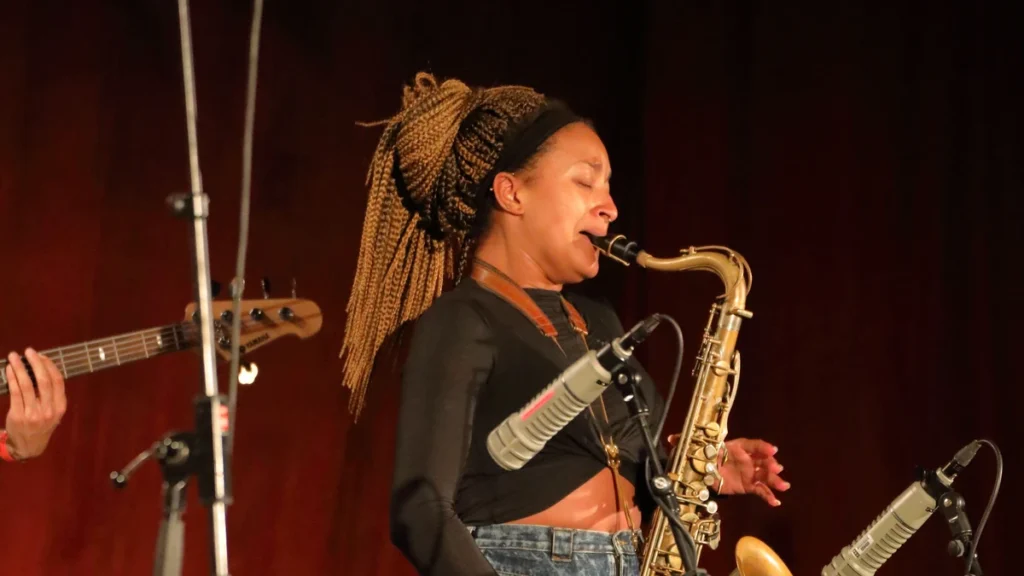
Nubya Garcia performing on tenor saxophone.
Nubya Garcia performing on tenor saxophone.
Nubya Garcia headlined the Vijazz festival in Vilafranca del Penedes in July, two years into the touring cycle behind her second album.
That record pairs orchestral arrangements with dub, which is a combination almost nobody attempts.
A Wine Town in Catalonia
Vilafranca del Penedes is a small town at the centre of a Catalan wine region, and its festival programmes jazz alongside the local industry.
European jazz festivals of this kind are the backbone of the international circuit, and most of them are in places nobody outside the region has heard of.
They are also where a substantial proportion of international jazz income is generated, which is why an artist’s summer routing looks like a tour of small European towns.
She shared the headline billing with Esperanza Spalding and Incognito, which is a bill spanning three quite different traditions.
Two Years of Touring One Album
The album arrived in September 2024, and the touring behind it has now run across two summers.
That is long by pop standards and normal in jazz, where albums are treated as calling cards rather than as products with a shelf life.
A jazz record generates very little income directly. What it does is justify bookings, and a well-received album can support two or three years of festival dates.
Orchestral Writing Plus Dub
The record combines written orchestral arrangements with dub production techniques, and those two things pull in opposite directions.
Orchestral writing is fixed. Every part is notated, the players read, and the arrangement sounds the same each time.
Dub is the opposite: a producer manipulating a recording in real time, dropping instruments out, drenching them in echo and rebuilding the track as a live process.
Putting both on one record means committing to a fixed score and then treating the recording of it as raw material, which is a genuinely unusual method.
Where Dub Comes From Here
The dub element is not decorative. Garcia is British of Guyanese and Trinidadian descent, and dub is part of the musical inheritance that shaped London.
Caribbean sound-system culture reshaped British music comprehensively, and its influence runs through genres that have no obvious surface connection to it.
A London jazz musician using dub techniques is drawing on a local tradition rather than importing a foreign one.
The London Scene She Came From
She emerged from a generation of London musicians who came up through the same youth programmes and community bands.
That scene reset international perceptions of British jazz, which had spent decades being treated as a provincial version of an American form.
What distinguished it was that its members drew on Caribbean, West African and electronic music as naturally as on the jazz canon, because those were the sounds they had grown up inside.
The Tenor Saxophone Position
She plays tenor, which is the instrument most associated with the jazz canon and therefore the one carrying the heaviest historical weight.
Every tenor player works in the shadow of a small number of figures whose recordings define what the instrument can do.
The way through is not to avoid the comparison but to have enough of an individual sound that it stops being the first thing anybody says.
Concord and the Independent Jazz Label
Concord Jazz is one of a small number of labels still funding jazz records at a scale that permits orchestral arrangements.
That is not a trivial thing. Hiring string players and recording them properly costs more than most jazz albums earn.
Labels able to underwrite it are the reason ambitious jazz records still get made, and there are fewer of them every year.
A First Headlining American Tour
She completed her first headlining tour of the United States in spring 2025, which is a specific milestone rather than a routine one.
British jazz musicians historically reached American audiences as support acts or festival additions, not as headliners.
Selling tickets under your own name in a country with its own deep jazz tradition is a considerably harder proposition than doing so in Europe.
Australia, Japan and China
The same year included dates in Australia, Japan and China, which describes a genuinely global touring footprint.
Japan in particular has one of the oldest and most sophisticated jazz audiences outside the United States, with a listening culture built around records and specialist bars.
Reaching that market matters commercially and reputationally, since Japanese jazz audiences are famously discriminating.
Spalding on the Record
Esperanza Spalding features on one track of the album, which makes their shared festival billing a reunion rather than a coincidence.
Festival programmers frequently build bills around existing relationships, because artists who have recorded together will usually appear on each other’s sets.
That is one of the quiet pleasures of the summer circuit: collaborations that exist on record become live for one night.
Why Jazz Albums Take Years to Tour
The extended touring cycle is a consequence of how the festival calendar works.
Most festivals run once a year within a narrow summer window, and a booking missed in one year cannot be recovered until the next.
An album released in September therefore cannot reach the European circuit until the following July, and covering the whole circuit takes at least two summers.
Small Festivals and Large Reputations
A headline slot at a small regional festival is worth more than it appears from outside.
These events have loyal local audiences, long histories and programmers whose choices are followed by their counterparts elsewhere.
An artist who plays well at one of them tends to find the following year’s offers arriving without being chased.
What the Album Was Trying to Do
The ambition is legible from the instrumentation alone: a saxophonist writing for strings while treating the studio as an instrument.
That places the record in a lineage of jazz musicians who used orchestral resources not for prestige but because the writing required them.
The risk in that approach is grandeur for its own sake, which is why the dub element matters. It keeps the record from becoming reverent.
How the European Circuit Actually Pays
The summer festival network is the financial spine of international jazz, and its structure is worth understanding because it explains almost every touring decision an artist makes.
Festivals pay a fixed fee agreed months in advance, which removes the ticket risk entirely. An artist knows what a date is worth before leaving home, and the fee does not change if it rains or if a bigger act is playing forty miles away the same night.
They also cluster geographically and chronologically. A musician can play six countries in ten days because the events are scheduled around each other, sharing artists and sometimes sharing production, which makes the economics work in a way isolated club dates never could.
The constraint is that it all happens between June and September. Nine months of the year the circuit does not exist, which is why jazz musicians teach, record, tour clubs and take session work for the rest of it.
What Gets Lost Between Record and Stage
An album with orchestral arrangements creates a specific problem the moment it has to be performed.
Strings do not travel. A festival fee that comfortably covers a quintet will not cover a quintet plus a string section, their flights, their accommodation and the extra freight, and no promoter will absorb the difference for a mid-bill act.
So the parts have to go somewhere else. They get played on keyboards, triggered from samples, redistributed to the horns, or simply dropped in favour of arrangements that use the band that exists.
Musicians differ on whether that is a loss or an opportunity. The version of a song that survives the reduction is often leaner and more direct than the recorded one, and audiences who know the album hear the difference as interpretation rather than absence.
What Is Actually Being Tested
Two things. Whether orchestral arrangements survive translation to a festival stage, where the string section stays at home and the parts have to be covered.
And whether a two-year touring cycle keeps a record alive or simply postpones the point at which the next one has to arrive.
One album, two summers, a Catalan wine town, a tenor saxophone, and a string section nobody can afford to take on the road.
About The Author