Perfume Genius Is Touring Glory as a Two-Person Show
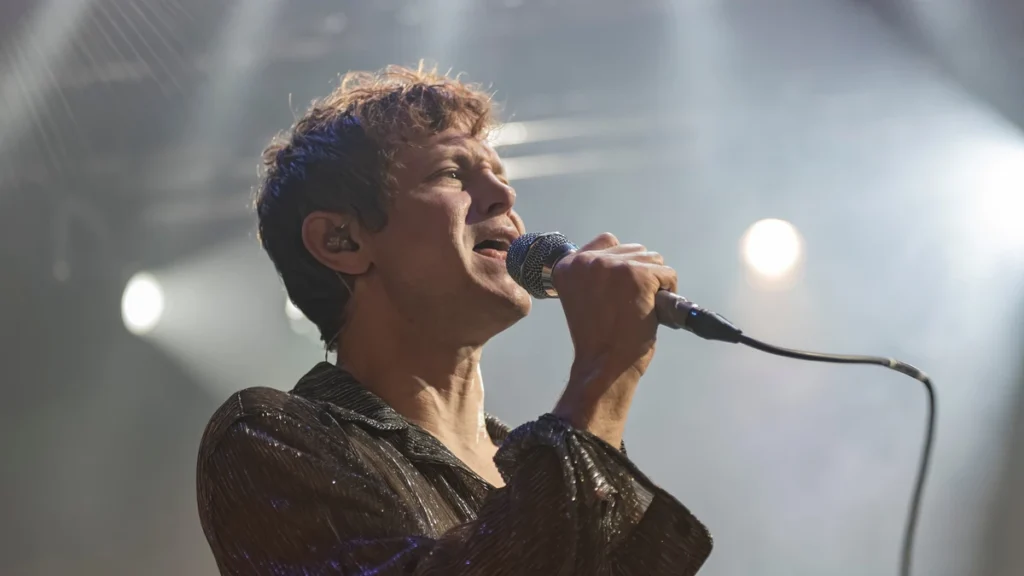
Perfume Genius performing in November 2025.
Perfume Genius performing in November 2025.
Perfume Genius is touring the album Glory as a duo, with Mike Hadreas singing and Alan Wyffels playing keyboards, and nobody else on stage.
The run opened in Chicago in January, broke for two months, and resumes at the end of March.
Two People and a Keyboard
The configuration is the entire story here, because Glory was not made this way.
The record is a full band album with drums, guitars and arrangements built in a studio over months, and the obvious way to tour it is with the musicians who played on it.
Reducing that to a singer and a keyboard player removes almost every element the songs were constructed around, which means the arrangements have to be rewritten rather than reduced.
What survives that process is a reasonable test of whether the songs were good before the production arrived.
Who Alan Wyffels Is
Wyffels is Hadreas’s longtime partner as well as his keyboard player and co-writer, which makes this a domestic arrangement as much as a musical one.
Couples who tour together are not unusual in music, but couples who tour as a two-piece with nobody else present are a much smaller category.
There is no band to absorb a bad night, no other musicians in the van, and no separation at all between the working relationship and the personal one for the length of the run.
Fifteen Years Back to the Start
The pair first performed together around fifteen years ago, and the duo format is what they used then.
The earliest Perfume Genius shows were exactly this: one voice, one keyboard, and material that had been recorded at home rather than in a studio.
Returning to that configuration after seven albums is a deliberate loop rather than a cost-saving measure, and the framing of the tour makes that explicit.
What Glory Actually Was
Glory arrived through Matador Records in March 2025 and runs to eleven tracks.
It is a warmer and more band-oriented record than its immediate predecessor, built around live playing rather than the processed textures that dominated the previous album.
Aldous Harding appears on one track, which is a pairing that makes sense on paper: two singers who both use their voices in ways that unsettle listeners expecting conventional phrasing.
The Grammy That Went Elsewhere
Glory was nominated for best recording package at the 68th Grammy Awards, held on 1 February 2026.
The award went to Tyler, the Creator, and the Perfume Genius nomination recognised the album’s art direction rather than the music itself.
Packaging categories are frequently dismissed as minor, which underrates how much of an album’s identity is established before anybody presses play.
A Tour Split Into Two Halves
The routing is unusual: the run opened on 22 January at Lincoln Hall in Chicago, then stopped for two months.
It resumes on 31 March at the Lincoln Theatre in Washington, and continues through Philadelphia, New York, Boston, Montreal and Toronto.
Splitting a tour that way is a scheduling choice rather than an artistic one, and it usually reflects a venue calendar, a recording commitment or simply a decision not to spend eleven consecutive weeks on the road.
Ending in a Town Nobody Tours
The final date is 9 April at the Center for the Arts in Homer, New York, which is a village in the centre of the state with a population in the low thousands.
Artists at this level do not usually finish a tour there, and the choice says something about what the duo format makes possible.
A two-piece can play a small arts centre profitably in a way a six-piece band cannot, which opens up a map of venues that are otherwise permanently out of reach.
What a Duo Does to a Song
Removing a rhythm section changes the fundamental unit of a performance from groove to phrasing.
With drums present, a song moves forward whether or not anybody is doing anything interesting, because the pulse carries it.
Without them, the tempo is whatever the two players decide it is at that moment, and a song can slow down, hang, or stop entirely if that is what the room seems to want.
That is either liberating or exposing depending on the material, and songs that relied on momentum tend not to survive the transition.
Where the Voice Sits Without a Band
The most immediate consequence is that the voice becomes the loudest thing in the room by a considerable margin.
Hadreas sings in a way that is already unusually exposed, moving between a near-whisper and full volume within a single phrase, and a band normally provides a floor underneath that.
Taking the floor away means every breath, every crack and every decision about where to place a syllable is audible to the back row.
Matador and a Long Relationship
Matador has released Perfume Genius records for the entire career, which is now an unusually long label relationship.
Independent labels rarely keep an artist across seven albums, because the economics usually push either the artist toward a major or the label toward newer signings.
Continuity of that kind gives an artist something increasingly rare: people who have heard every record and can tell whether a new one is a development or a repetition.
Seven Albums Across Fifteen Years
The catalogue now runs to seven studio albums, beginning with a home-recorded debut in 2010.
The trajectory from that record to the present is one of the more complete transformations in recent independent music, moving from lo-fi piano songs to full studio productions without abandoning the original register.
What connects them is subject matter rather than sound. The songs have consistently been about bodies, shame, illness and desire, and the production has changed while the concerns have not.
The Dance Piece That Became an Album
One of the previous albums grew out of a collaboration with a choreographer, in which Hadreas performed as a dancer rather than only as a singer.
Writing music for bodies moving through space produces different material than writing songs, because the structure is dictated by choreography rather than by verses and choruses.
That record is the least conventional in the catalogue, and the album that followed it was noticeably more direct, which is the usual pattern after an experiment.
Why Stripping Back Is a Risk
Acoustic and reduced tours are often assumed to be safe, and the assumption is backwards.
A full band is a considerable safety net. Volume covers a great deal, arrangements are rehearsed, and the audience’s attention is distributed across several players.
Two people have none of that. Every gap is real silence, and an audience that stops paying attention has nothing to look at.
Small Rooms as a Deliberate Choice
The venues on this run are mostly theatres and clubs in the several-hundred to low-thousand range rather than the larger rooms a full band tour would target.
That is a decision to trade gross revenue for a particular kind of evening, since the format only works in a room where quiet is possible.
Artists who can fill larger venues and choose not to are making a statement about what the performance is for, and audiences generally read it correctly.
What Partnership Does to a Performance
Two musicians who live together play differently from two musicians who work together, and the difference is legible from the audience.
Anticipation is the main one. A phrase that slows down does not need a cue, because the other player has heard that hesitation in a kitchen as well as on a stage.
The risk is the same thing inverted. A bad week is not left at the venue door, and there is no third person present to reset the atmosphere.
Why Artists Return to Their First Format
Going back to the configuration you started with is a recurring move late in a career, and the motivation is rarely nostalgia.
The usual reason is diagnostic. A songwriter who has spent a decade adding layers eventually wants to know which songs still function with everything removed, because that is the only way to find out whether the writing or the production was carrying them.
It is also a way of testing an audience. People who came for a spectacle will not enjoy a two-piece, and the ones who remain are the ones who were listening to the songs.
Doing it after seven albums rather than after two is what makes it interesting, because there is now a substantial body of material that was never designed to be played this way.
What Is Actually Being Tested
Two things. Whether a full band album survives being played by two people, which is a question about the songs rather than about the performance.
And whether a fifteen-year loop back to the original format reads as a return or as a retreat, which the room will decide nightly.
One voice, one keyboard, a Chicago club in January, a village arts centre in April, and nothing on stage to hide behind.
About The Author