Christian McBride and Brad Mehldau Are Touring as a Duo
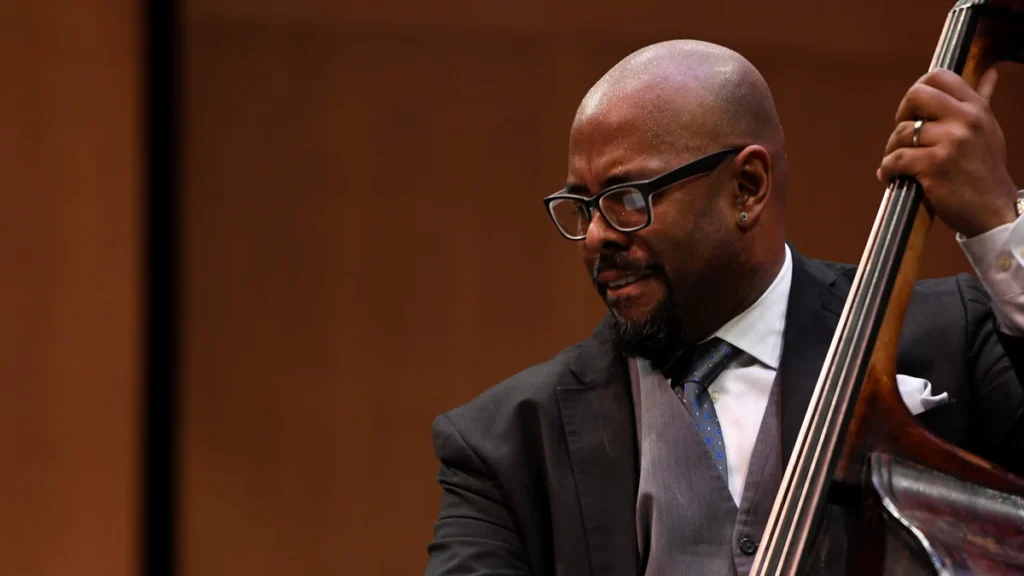
Christian McBride performing on upright bass.
Christian McBride performing on upright bass.
Christian McBride and Brad Mehldau are performing as a duo across the current season, bass and piano with nothing else on stage.
The dates run through concert halls as well as clubs, including a jazz series at Symphony Center in Chicago.
Two Instruments and No Drums
The bass-and-piano duo is one of the most exposed formats in jazz, and the reason is what is missing.
In a standard trio the drummer keeps the time, which frees the bassist to move between anchoring the harmony and playing melodically.
Remove the drums and the bass becomes responsible for both at once: the pulse and the harmonic foundation, with no cymbal marking where the beat is.
Every hesitation is audible, and there is nowhere for either player to hide behind volume or density.
Why the Format Is Rare
Duos of this kind are performed far less often than the recorded history suggests, and the obstacle is practical.
Two musicians who do not already have deep rapport cannot sustain ninety minutes without a rhythm section, because the conversation has to carry the entire performance.
It requires players who can anticipate each other’s phrasing, which comes only from having played together over years rather than from rehearsal.
They Have Worked Together Before
The two have performed together previously, including a tour as a trio with a drummer, which is the usual route into a duo.
Trios establish whether two players actually hear the same things, with the drums providing cover while that gets worked out.
Stripping back to a duo afterwards is a decision made once both are confident the material survives the reduction.
Concert Halls Rather Than Clubs
Booking a jazz duo into Symphony Center places the performance in a classical concert environment rather than a jazz one.
That changes the evening substantially. The audience is seated, silent and facing forward, and there is no bar noise or table service to play over.
For quiet music it is a considerable advantage. A duo playing at low volume in a club is competing with the room; in a concert hall the room is on their side.
Opening an Anniversary Season
They also open the Clarice Smith Performing Arts Center’s twenty-fifth anniversary season, which is a specific kind of booking.
Anniversary programming is chosen carefully, because the opening night sets the tone for everything that follows.
Selecting a jazz duo rather than a large ensemble suggests a venue confident that its audience will sit with something quiet and demanding.
The Blue Note Half of the Run
The same touring includes a run at the Blue Note in New York, which is the opposite environment.
Club audiences sit close, drink, and respond audibly, and the music has to work in a room with a different energy entirely.
Playing the same duo material in both settings is genuinely difficult, and the arrangements usually have to shift between them.
McBride’s Position in the Music
McBride is among the most recorded bassists of his generation, with a career spanning straight-ahead jazz, funk, and work with singers across several genres.
He also occupies institutional roles, hosting radio and holding artistic directorships, which places him at the centre of how American jazz is presented.
That breadth is unusual. Most musicians at his level either play or administrate, and doing both requires a schedule most would not attempt.
The Bassist Who Talks
His public role as a broadcaster is a meaningful part of the picture, because jazz has a persistent communication problem.
The music is frequently presented as difficult, and the people best placed to explain it are often the least inclined to try.
A working bassist who can describe what is happening in a performance to a general audience is doing something the field structurally needs.
Mehldau’s Recent Recording
Mehldau’s recent work includes an album built around music by the songwriter Elliott Smith.
Jazz pianists interpreting songwriters from outside the tradition is well established and frequently goes badly, producing versions that flatten the original into a set of chord changes.
The successful approach treats the song as a structure worth respecting rather than a vehicle, which requires actually liking the source material.
Interpreting Songs Rather Than Standards
The jazz standard repertoire was largely written between the 1920s and 1950s, and it has been thoroughly worked.
Musicians looking for fresh material have increasingly turned to later popular songwriting, which brings different harmonic and structural assumptions.
Those songs were not written to be improvised over, which is precisely what makes them interesting to a player looking for resistance.
What a Season Booking Means
Being programmed into a symphony orchestra’s season is a different arrangement from a normal tour date.
Season programmes are assembled a year or more ahead and marketed as a package, with subscribers buying multiple concerts rather than single tickets.
That gives the artists an audience who did not specifically choose them, which is either an opportunity or a difficulty depending on the performance.
The Economics of Two People
A duo is the cheapest possible touring configuration above a solo performance.
Two fees, two flights, two hotel rooms and almost no equipment beyond a bass that has to travel carefully.
That economy is why duos persist despite being harder to play, because the format lets musicians tour venues that could not support a quintet.
Travelling With an Upright Bass
The practical difficulty in this format is the instrument itself, which is large, fragile and expensive.
Bassists either buy a seat for it, ship it in a flight case that costs more than most instruments, or hire locally and accept an unfamiliar instrument.
None of those options is good, and the choice shapes touring decisions in ways audiences never see.
Why Quiet Music Needs the Right Room
A duo playing at conversational volume depends entirely on the acoustics and the audience’s willingness to listen.
In a good hall the instruments carry without amplification and the silence between phrases becomes part of the music.
In a bad room the same performance is inaudible past the tenth row, which is why the venue choice matters more here than for almost any other format.
What the Drummer Was Actually Doing
The clearest way to understand a duo is to list what disappears when the drums leave, because it is more than timekeeping.
A drummer marks the form. The audience knows a chorus has ended because a cymbal crash tells them, and the other players know where they are in a thirty-two bar structure without counting. Remove that and both musicians have to hold the form internally while also playing.
A drummer also supplies dynamics. A build is created by adding density and volume behind the soloist, and a release by dropping to brushes. A duo has neither option: the only way to build is for two people to play more, and the only way to release is for one to stop.
What is gained is transparency. Every harmonic choice the pianist makes is audible because nothing is covering it, and every note the bassist plays is a decision rather than a function. Audiences who find trios comfortable often find duos unexpectedly gripping for exactly that reason.
Why Jazz Keeps Reaching for Newer Songs
The standards repertoire is finite, and after a century of recording it has been examined more thoroughly than almost any body of music.
That creates a problem for improvisers. A musician playing a song that has been recorded ten thousand times is competing with an enormous documented history, and originality becomes progressively harder to find inside material everyone knows completely.
Later popular songwriting offers resistance instead. Songs from the last fifty years were written for voices and guitars rather than for horn players, with structures that do not divide neatly into thirty-two bars and harmony that does not always move where a jazz musician expects.
That awkwardness is the appeal. A song that fights the treatment forces genuine decisions, and the results tend to sound like discovery rather than like another pass through familiar changes.
What Is Actually Being Tested
Two things. Whether a duo can hold a full concert hall across a season, which requires sustaining attention without the dynamic range a band provides.
And whether two musicians with long individual careers can subordinate them to a conversation, which is the whole proposition of the format.
Two instruments, no drums, a concert hall in Chicago, a club in New York, and nowhere at all to hide.
About The Author